A slip-sheet is a thin sheet with lips on which a load unit is built instead of a pallet. It is handled by a push-pull attachment on a forklift, so having that attachment at both ends is the precondition. In return you recover the height the carrier occupies, the mass of the wood, and the entire pallet-return problem.
What unloading a slip-sheeted unit looks like
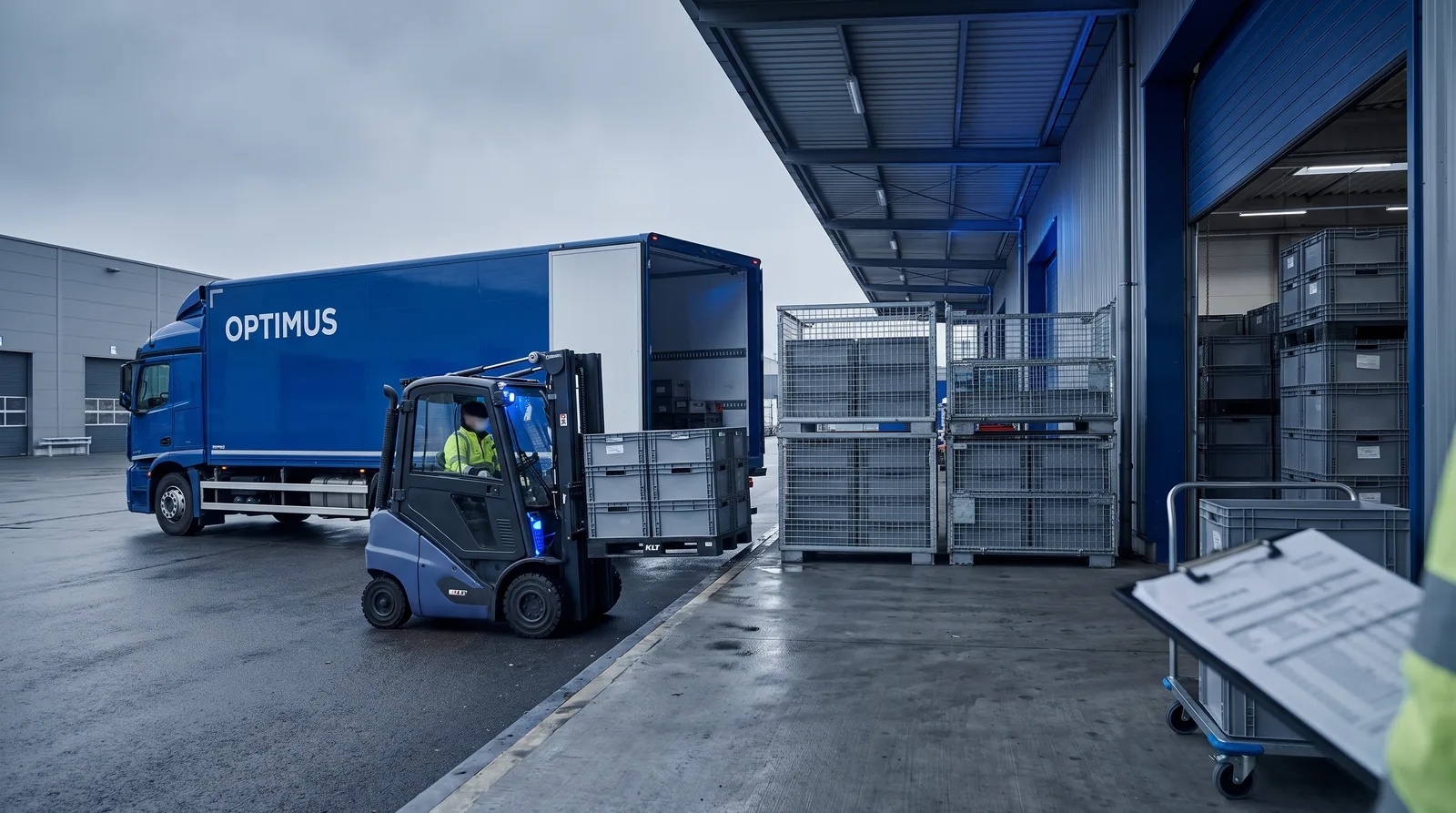
The truck approaches with a push-pull platen instead of forks. The gripper takes the lip, draws the whole unit onto the platen, the truck reverses and sets the load down — on the floor, on the consignee's own pallet, or on a conveyor. The whole operation resembles pulling a sheet of paper off a table with everything standing on it, and it demands a genuinely tight build: layers have to hold each other, because during the pull the entire body is dragged by one side.
Hence the first practical consequence: wrapping a slip-sheeted unit serves a different purpose than on a pallet. On a pallet the film anchors the load to the carrier; here it must bind the layers to each other while leaving the sheet free enough to be gripped. Wrapping rules for wooden carriers are in stretch wrapping to DC requirements.
Do slip-sheets bypass ISPM 15?
ISPM 15 applies to solid wood packaging. British rules state plainly that they do not apply to processed materials such as cardboard, so a board or plastic sheet is not wood packaging and needs neither a mark nor heat treatment. That is a real argument on flows where sourcing correctly marked pallets is a bottleneck; the wood question itself is covered in ISPM 15 and wooden pallets to the UK.
Beware the usual mistake: dropping the pallet exempts you from nothing else. Documents, labels and consignee requirements stay the same, and with food loads there is the further question of the sheet material in contact with product.
What you actually gain
Three items, each measurable. Height: a euro pallet is 144 mm, a sheet a few millimetres — on a load capped by goods-in height or trailer internal height, that is recovered space for another layer. Mass: EPAL puts euro pallet own weight at approximately 25 kg, and a sheet weighs a fraction of that; how much that yields on a full vehicle is calculated in pallet tare in payload maths. Return: the sheet is one-way and generates no balance, no notes and no arguments about unit grade — the problem set out in pallet exchange and pallet notes.
What you do not gain is loading metres: the footprint is unchanged, so the number of units on a trailer stays the same. The counting method is in how many pallets go to the UK and how to count LDM.
Will every UK warehouse handle a slip-sheet?
No, and that is the technology's main constraint. A push-pull attachment is not standard equipment; the warehouse must own one and have an operator who uses it routinely. Before a first shipment the question to the consignee is blunt: do you have a push-pull attachment and will you accept a unit with no pallet. "We will manage" is not an answer, because without the attachment the only route is breaking the unit down by hand at the ramp.
The halfway solution we use most often is changing the carrier en route: goods leave Poland on a slip-sheet and at the Milton Keynes warehouse we transfer the unit to whatever pallet the consignee requires. We document it with a repacking record, because the carrier changes and often the unit count with it.
When a slip-sheet makes no sense
When the load goes straight into racking — a unit without a pallet cannot be placed in a racking location without transfer. When several transhipments are expected, because each grip stresses the lip and the unit. When the load is heavy in point terms and needs a rigid base to spread pressure. When the unit will stand in damp conditions — a board sheet then loses stiffness and the lip tears on gripping. And when the consignee runs a returnable carrier loop, because then the pallet is not a cost but part of a system; the non-wood alternative is covered in plastic and metal pallets on UK exports.
Who it genuinely works for
Steady, one-way flows to a single consignee with the equipment: a manufacturer shipping the same thing weekly to the same warehouse. There the height and mass savings compound across a year, and the absence of a returnable carrier reduces accounting to nothing. For irregular shipments to changing consignees through consolidation, a slip-sheet is more problem than solution — there a plain one-way pallet is the safer route.
Sources
- GOV.UK: ISPM 15 requirements for wood packaging and exclusions for processed materials
- EPAL: 144 mm height and euro pallet own weight of approximately 25 kg
Considering dropping the pallet on your lane? Describe the load and the consignee in the quote form and we will check whether a carrier-free unit stands a chance at goods-in. The lane is described on our transport to the United Kingdom page.