Westpoint Exeter lies at Clyst St Mary outside Exeter in Devon, postcode EX5 1DJ, close to junction 30 of the M5. The venue publishes over 4,500 sqm of column-free covered space, six-metre roller doors giving access to pantechnicon vehicles, ground floor access with numerous load-in points, and 150 acres of outdoor ground crossed by a network of internal roadways.
Where it sits: the end of the motorway network
The venue quotes access from the M5 and the A303 and describes itself as close to M5 junction 30. This is the last stretch of motorway in this part of the country: further west, towards Cornwall and Plymouth, the roads become the A30 and A38 with a varying cross-section. For planning a run from Poland that makes Exeter a natural point at which to split the journey. A load going further west loses more time over the next hundred kilometres than over three hundred kilometres of motorway, which shows in a delivery to the Royal Cornwall Events Centre near Wadebridge.
The venue publishes no mileage from the junction and no gate names. What it does publish is its own what3words reference, an address of three words identifying a specific square of ground. Across 150 acres that genuinely helps, because one postcode serves the whole site while there are several ways in.
Six metres of clear door height
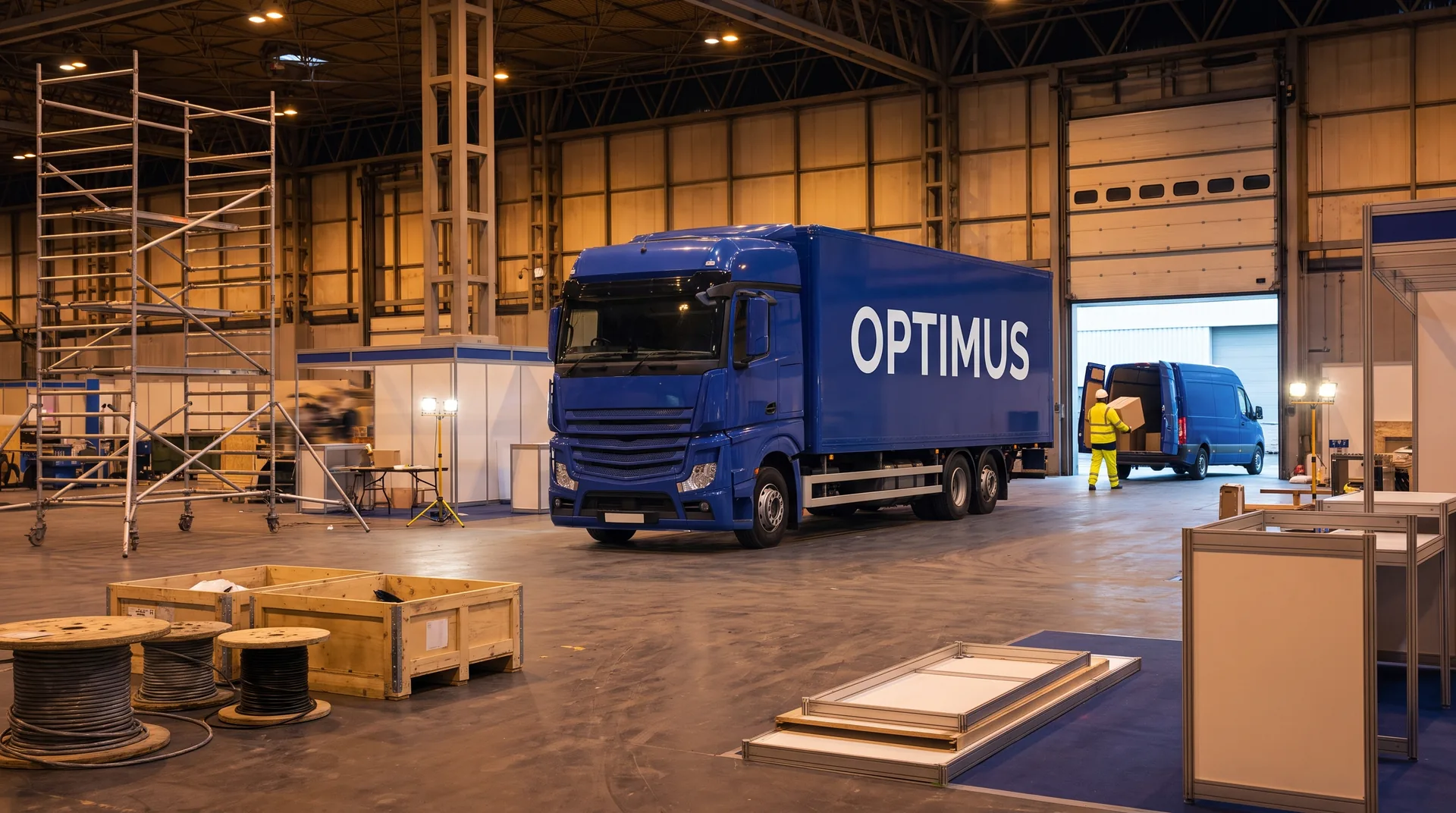
The key figure at this venue is not a floor area but a height. The venue states plainly that its roller doors are six metres high and provide access for pantechnicon vehicles, the large-volume box vans used for furniture and displays. In practice that means the load does not have to be broken down outside and carried in: the vehicle drives in, stops at the plot and unloads where the stand is being built.
That is rare. Most city venues take deliveries through a bay or a dock, and there the vehicle journey ends, with venue equipment taking over. Here the vehicle journey ends at the stand. It changes two things at once: it shortens the unloading and it cuts the number of handling steps, and every handling step is where damage most often starts. The limits of carrier liability in such operations are set out in the article on responsibilities at a trade fair.
One caveat follows from the same point: the right to drive into the hall comes from the organiser, not from the door dimension. At many events access for an outside vehicle is restricted or reserved for the official freight agent. We unpack the distinction in the article on the official fair forwarder versus your own carrier.
One hundred and fifty acres of field with a road network
The venue describes its outdoor ground as 150 acres of rolling green fields and woodland, a typical Devon rural setting, crossed by a network of roadways covering the entire showground. Parking takes over two thousand cars and the venue describes it as level.
For a carrier that description says two things. First, the internal road network allows a heavy vehicle to reach the depth of the site, which cannot be assumed at every showground. Second, if the plot is on the field rather than beside a road, then the surface under it is turf, with everything that implies after rain. The venue does not publish a split between grass and hard standing, so the surface under a given plot is confirmed with the organiser rather than read off the site description. We describe the same mechanism at the Royal Highland Centre at Ingliston.
The line that reshapes a driver day
In its visitor information the venue states a no overnight stay rule on site. It reads like housekeeping, but on a delivery from Poland it is part of the timetable. A driver who arrives after the build-up window closes will not wait on site until morning: he needs a nominated place to stop outside the venue and to take his rest there. On a route measured in two days of driving plus a ferry crossing, that single rule can move the whole gate time by half a day.
So at this venue we build the slack into the arrival side of the calendar rather than the departure side. The method for counting deadlines backwards from the build-up window is in the article on the build-up and breakdown calendar, and the consequences of being late in the piece on dispatch deadlines and late delivery.
Restrictions and zones
No charging clean air zone applies around Exeter. The British list of charging zones covers Bath, Birmingham, Bradford, Bristol, Portsmouth, Sheffield and Tyneside, with the London ULEZ and LEZ operating separately. Coming from the east, Bristol matters on the route, but the M5 bypasses that city zone. The venue publishes no weight or height limits and no bridge warnings.
What to settle before arrival
- Whether the stand is in the hall or outdoors, and the plot number.
- Whether the organiser allows a vehicle into the hall or unloading happens outside the doors.
- The surface under an outdoor plot.
- The nominated entrance and its what3words reference, if the venue issues one for that event.
- Where the vehicle parks after unloading, off site.
- Who supplies the forklift on build-up day.
What we do at our end
We collect stands and exhibits in Poland, and from exhibitors in Czechia, Slovakia, Austria and Hungary we gather the load through our hub. At the Kielce base, about 4 km from the fairground and open around the clock, we assemble a stand into one consignment before departure. A groupage vehicle waits for the next scheduled line departure. Clearances run in cooperation with the customs agencies we work with regularly on both sides. On the British side the load usually passes through a cross-dock at our warehouse in Milton Keynes, which gives two transhipments across the route. We deliver to the handover point and commit to an hour at the gate rather than an hour of unloading.
Groupage or a dedicated vehicle
The threshold runs at roughly a third of a trailer, about twelve pallets. At Westpoint an argument appears that city venues do not offer: with six-metre doors and no columns, a dedicated vehicle genuinely shortens the build, because it drives to the stand and leaves empty the same day. For a stand of panels and printed material groupage is still enough. We set out the differences in the article on choosing between FTL and groupage.
Sources
- Westpoint Exeter: the arena, column-free space and roller doors
- Westpoint Exeter: directions, the M5 and the what3words address
- Westpoint Exeter: external grounds and internal roadways
- GOV.UK: list of British charging clean air zones
Exhibiting near Exeter? Send the plot number, the dimensions of the heaviest item and the build-up window through the quotation form and we will set the delivery to the door or to the stand. See also the exhibition logistics page.