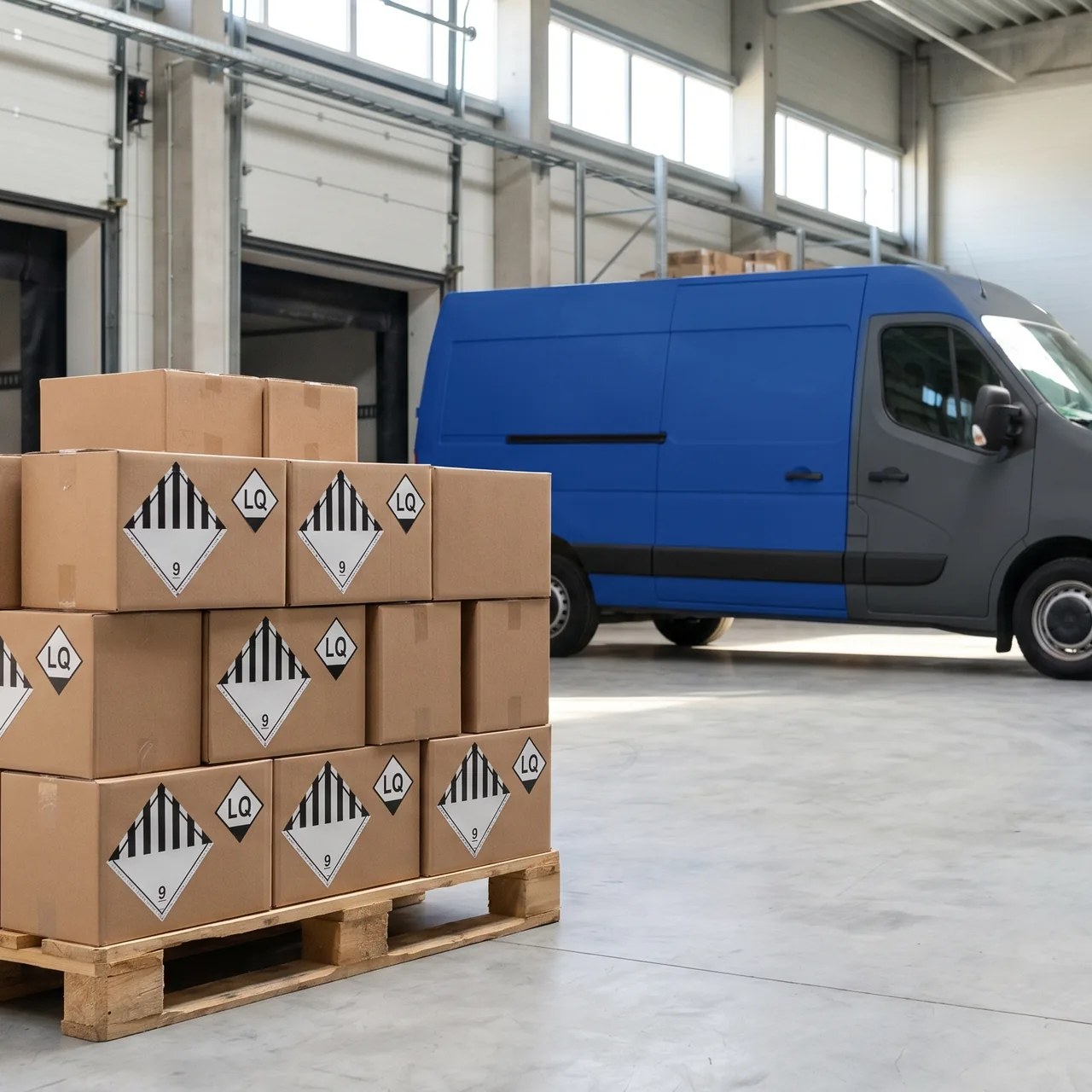
Limited quantities, LQ for short, are an ADR exemption for dangerous goods packed in small inner packagings. A consignment meeting the LQ conditions travels under simplified rules with its own marking, but the quantity thresholds depend on the specific UN entry and are not the same for every product.
Why limited quantities exist at all
If every movement of an aerosol, a paint or an adhesive required the full ADR regime, retail distribution would grind to a halt. The LQ exemption exists so that small consumer packagings can travel without orange plates, without an ADR certificate for the driver and without full vehicle equipment. It is not a loophole but a deliberate compromise: the risk from a small packaging is different from the risk from a drum.
When a consignment qualifies as LQ
- The goods must be authorised for carriage in limited quantities: not every UN entry allows it.
- The capacity or mass of the inner packaging must not exceed the value given for that UN entry.
- The outer packaging must meet requirements on construction and gross mass.
- The package must carry the LQ mark in the required size.
- The transport paperwork must reflect the actual method of packing.
The key sentence is this: the limit attaches to the UN entry, not to a product category. Two paints with different UN numbers can have different thresholds even though they sit next to each other on a shelf.
What LQ does not exempt you from
The relief covers part of the requirements, not all of them. The goods remain dangerous goods: packaging quality rules apply, mixed loading prohibitions with certain classes apply, load securing requirements apply, and at larger quantities tunnel restrictions may too. Neither carrier nor shipper stops being responsible for correct classification simply because the consignment travels as LQ. The classes and what they mean are described in ADR classes 1 to 9, and the basics in ADR transport.
The most common LQ mistakes
First: assuming that because the goods are in small packagings, LQ applies automatically. It does not, if the UN entry does not provide for it. Second: exceeding the gross mass limit for the outer packaging while the inner packagings are correct. Third: a missing or undersized LQ mark on the carton, which an inspection treats as no marking at all. Fourth, and most expensive: a description in the paperwork that does not match the contents, so an inspection reads it as carriage without required safeguards. The effects of poor goods descriptions are covered in an incomplete packing list.
LQ in groupage to the United Kingdom
LQ consignments are usually suitable for consolidation, but that does not remove the need to check what travels alongside: some class combinations are excluded regardless of packaging size. So when an LQ load is offered we ask for the UN number, not only the trade name of the product. Mixing rules are described in ADR in groupage LTL, and crossing restrictions in ADR by ferry and Eurotunnel. Lithium batteries are worth checking separately, with their own regime described in shipping lithium batteries.
How to check before shipping
The practical order is simple. Find the UN number in the safety data sheet. Check in the current edition of ADR whether limited quantities are provided for that entry and what the inner packaging limit is. Weigh and measure your packagings. Check the gross mass of the package. Only then apply the LQ mark to the carton. If any of those steps leaves doubt, the consignment should travel under the full ADR regime: more expensive, but cheaper than a vehicle stopped at an inspection. Our service scope is on the ADR transport page and the cargo types on the ADR and chemicals page.
Sources
- UNECE: the ADR agreement, current editions and annexes
- HSE: carriage of dangerous goods in the United Kingdom
Not sure whether your consignment fits within limited quantities? Attach the safety data sheet and packaging details through the quote form and we will check the classification before loading. This text is informational and does not constitute legal advice.