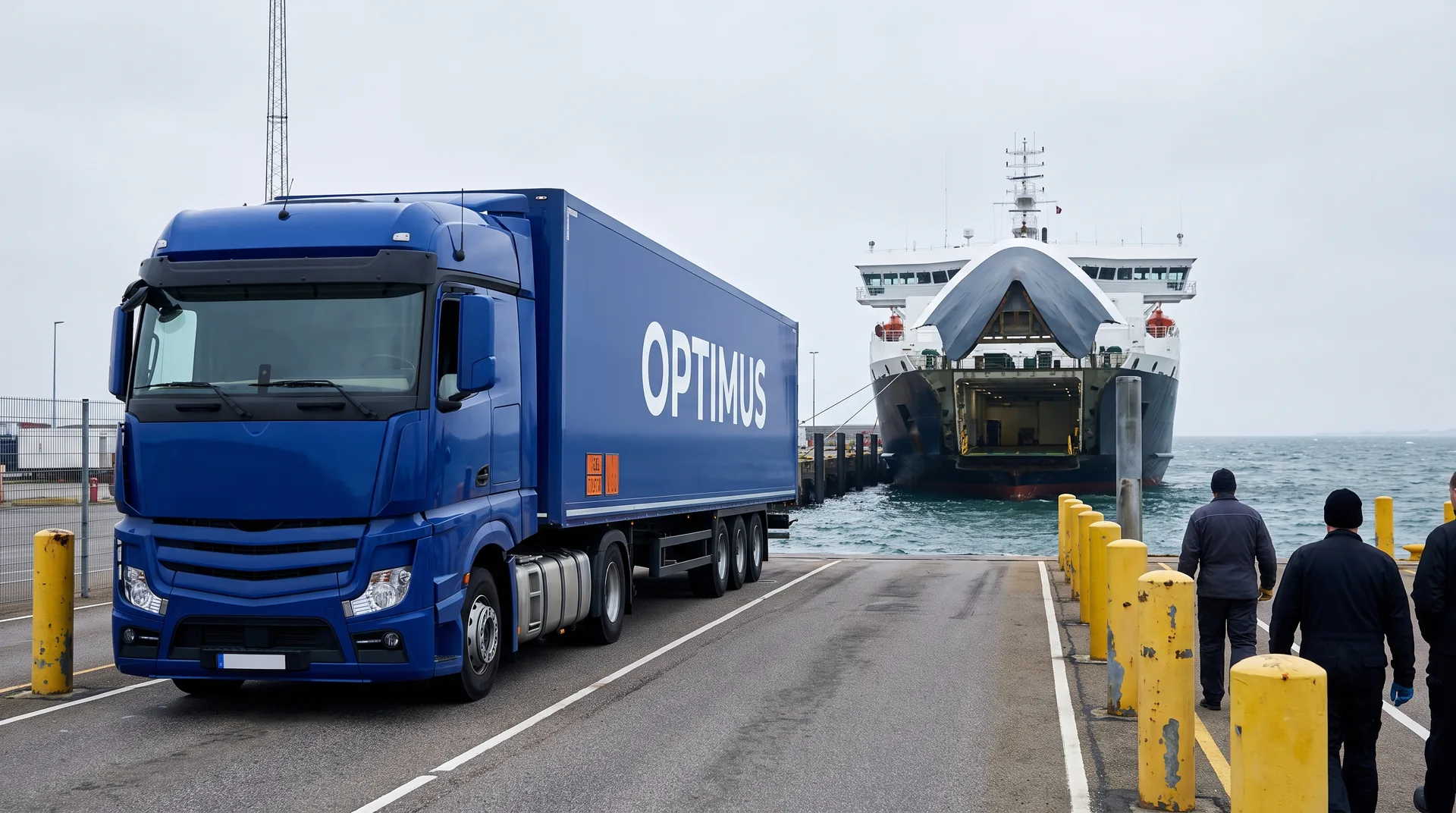
ADR is the international agreement governing the carriage of dangerous goods by road. It sorts cargo into hazard classes 1 to 9 and sets out how it must be packed, marked and documented, what equipment the vehicle must carry and what qualifications the driver needs. The rules apply whether the movement is domestic or international.
How to tell whether a load falls under ADR
The starting point is not intuition but a document: the product safety data sheet. That is where the manufacturer states the UN number, hazard class and packing group. If the sheet carries a UN number, the movement falls under ADR, though not necessarily in full, because exemptions exist for small quantities. If there is no UN number, the question ends there. The worst scenario is sending goods without checking and discovering the problem at a roadside inspection, where both carrier and shipper carry the consequences.
Hazard classes and what follows from them
ADR assigns every product to one of nine classes, from explosives to miscellaneous entries. The class determines package marking, packaging requirements and whether a given load may travel alongside another at all. Some classes are excluded from certain routes and modes, which we cover in ADR by ferry and Eurotunnel. An overview of all classes is in ADR classes 1 to 9.
What an ADR-compliant movement must have
- A transport document describing the goods in the order the agreement requires: UN number, name, class, packing group, number and type of packages, net mass.
- Packaging approved for the goods in question, marked with the appropriate hazard labels.
- Vehicle marking: orange plates and, on some movements, placards on the unit.
- Emergency equipment prescribed for the class and mode of carriage.
- A driver holding a valid ADR certificate covering the cargo being carried.
- A dangerous goods safety adviser on the side of the parties involved, to the extent the rules require.
Exemptions: not every movement means full ADR
The agreement provides relief for small quantities, so some shipments avoid the full regime. The most common is limited quantities, or LQ, used for goods packed in small inner packagings. An LQ shipment has its own marking and simplified requirements, but the quantity thresholds depend on the specific UN entry and are not uniform. We describe the mechanism in ADR and limited quantities. A separate and often surprising group is lithium batteries, covered in shipping lithium batteries.
ADR in groupage: what can travel together
Carrying dangerous goods in consolidation is possible but not unconstrained. Mixed packing and mixed loading rules exclude certain class combinations in one loading space. In practice that means not every line vehicle will accept every ADR consignment, and the decision is taken before loading, not at the ramp. We take the subject apart in ADR in groupage LTL.
ADR to the United Kingdom after Brexit
The ADR agreement itself applies in the United Kingdom as it does in EU states, because it is an instrument of the European economic commission rather than of Union law. What changed is the customs layer: export and import declarations and a GMR for the crossing are added to the ADR requirements, and some substances are additionally subject to licensing. We describe the consequences in ADR to the UK after Brexit and in import licences for GB.
What to prepare before sending an enquiry
To assess a movement we need the UN number, class, packing group, net mass of dangerous substance, the type and number of packages and whether the goods are packed as LQ. The safety data sheet contains all of it, so the simplest route is to attach it. The service scope is on the ADR transport page, and the cargo types we handle on the ADR and chemicals page.
Sources
- UNECE: the ADR agreement and dangerous goods rules
- HSE: carriage of dangerous goods in the United Kingdom
Not sure whether your goods fall under ADR? Attach the safety data sheet and a description of the consignment through the quote form and we will check the classification and the options. This text is informational and is not legal advice.