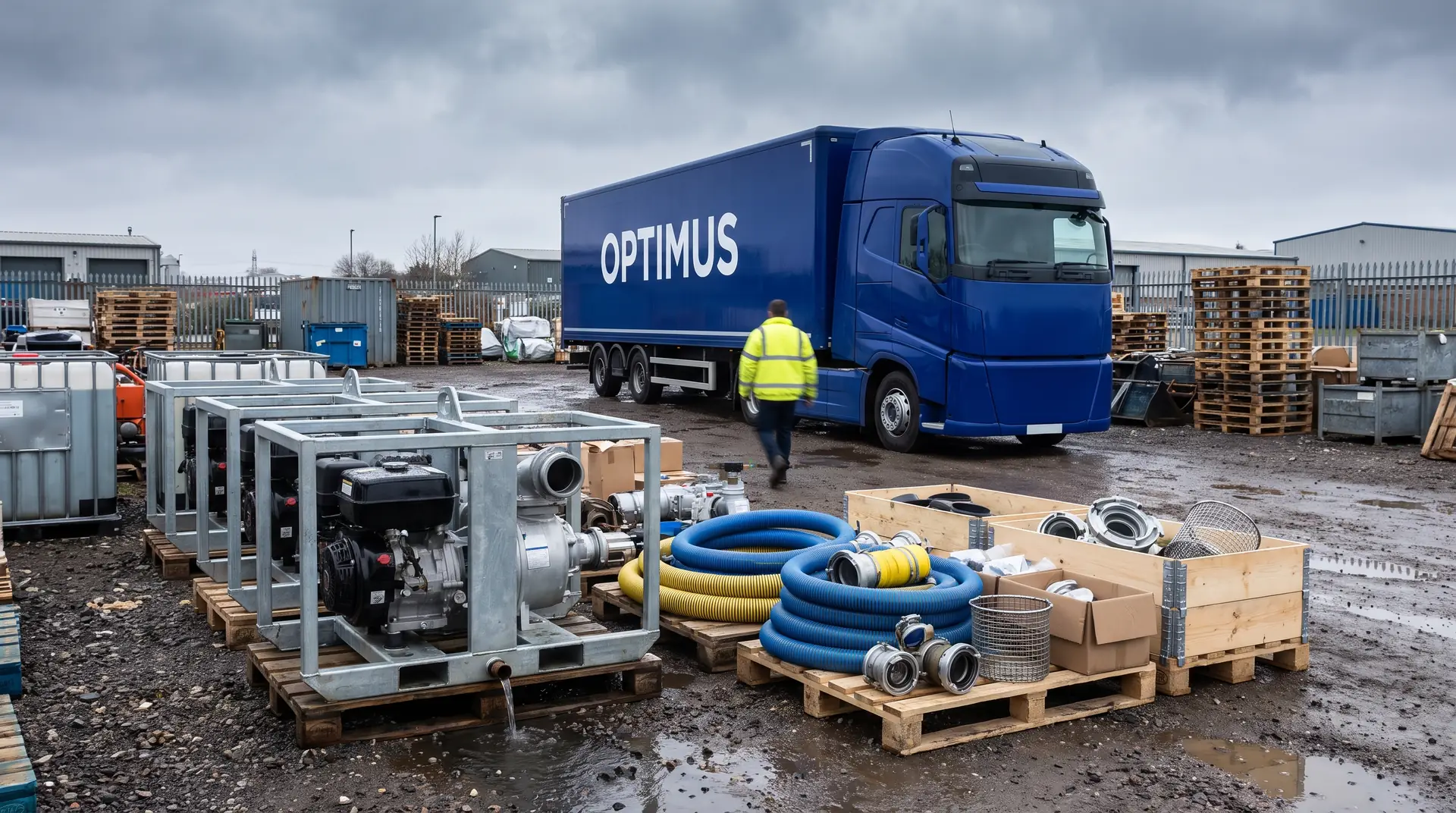
A dewatering pump from a British auction travels as groupage cargo, most often in a batch of several or a dozen units after a hire fleet disposal. Before carriage the water and the fuel are drained: water is weight and a risk of splitting the casing in frost, fuel is a matter of regulations. Hoses, fittings and strainers are packed separately and entered as separate lines.
Why batches are combined
Rental firms replace dewatering fleets wholesale, so this equipment appears at auction in runs. A single pump does not justify a vehicle of its own, but a dozen units from one yard does, and under our groupage model it pays to combine them into one load. The consolidated vehicle waits for the next scheduled line departure and splits the cost between the lines, so the buyer pays for space taken and weight. The threshold above which a dedicated run comes into consideration runs at roughly a third of the trailer, about twelve pallets. We describe the model more fully under small plant groupage from UK auctions, and site support equipment in the piece on generators, compressors and site containers from UK auctions.
Water in the casing and the hoses
This is what makes the category particular and it is the commonest source of trouble. A pump taken off a site holds water in the casing, in the suction hose and in the manifold, and in sub-zero temperatures water in a closed casing splits the housing and cracks the impeller. On top of that, water left from dewatering an excavation is often silted and oily, so a spill on the deck dirties the neighbouring load. Drain plugs are opened on the yard, the casing is emptied and left open to dry, and hoses are coiled only once they have drained. On diaphragm and slurry pumps the chamber has to be cleaned as well, because sediment sets like stone.
Fuel, battery and frame
- The fuel level is agreed with the yard before collection. Whether the movement falls under dangerous goods rules depends on the fuel type, the tank construction and its contents, not on the device being small.
- On pumps with electric starting the battery is disconnected and the terminals protected.
- Pumps in a protective frame are lashed by the frame, not by the casing or the engine; a lifting eye in the frame is for lifting, not for lashing points, unless the maker says otherwise.
- Versions on a single axle chassis can be wheeled around the yard, but for carriage they go onto the deck: towing such a chassis across the crossing is out.
- Wooden pallets and stillages used for carriage fall under the requirements for wood packaging material, described in the piece on the ISPM 15 standard.
Hoses and fittings as separate lines
A suction hose with a strainer, a delivery hose and a set of couplings are not pump equipment as far as the paperwork is concerned but separate goods with their own description, quantity and apportioned value. When a set is bought in one lot, the price therefore has to be broken down in a way the auction documents can justify. Customs value rests on the price actually paid; how it is established is described in the piece on the customs value of a used auction machine. Declarations are filed by the regular customs agencies we work with on both sides of the Channel, and our part is making the loading list match the contents of the trailer.
Lashing in groupage
A pump in a protective frame is a compact load and relatively heavy for its size, so under braking it slides rather than topples. A mechanical block, standing it against a headboard or adjacent loads, works better here than adding straps, and lashings pass through the frame. With a batch of a dozen units we lay them in a single layer or stand them on pallets, heavier ones at the bottom. The rules for choosing lashings are described in the article on cargo securing under EN 12195.
Cleaning and formalities
A pump used to dewater excavations is silted inside and out. Washing it before packing is the condition for entering groupage, because the equipment travels beside someone else goods. If the device has been used for agricultural or forestry purposes, the phytosanitary conditions may apply on entry into the Union, with a notification in TRACES NT and a CHED-PP certificate and the importer entered in the register kept by the Polish plant health service; we set the procedure out under farm machinery auctions in the UK.
Sources
- GOV.UK: moving dangerous goods
- IPPC: ISPM standards, including ISPM 15 for wood packaging
- GOV.UK: securing loads on HGVs and goods vehicles
Have several lots of dewatering equipment from one yard? Send the listing, weights and address through the quote form and we will build one shipment out of it. See also groupage LTL and customs clearance. From the same category: wheeled excavator transport from the UK.