Generators, compressors and site containers have one advantage over self-propelled machines: they can be weighed and measured as a whole, so choosing the vehicle is straightforward. The difficulty lies elsewhere. Fuel is left in the tanks, oil in the circuits and a battery in the control cabinet, and those three things have to be settled before the unit goes onto the trailer.
Fuel, oil and the dangerous goods rules
A generator bought at auction usually arrives with a residue of diesel in its built-in tank, and sometimes with a full day tank. Whether such a movement falls under ADR depends on the type of fuel and on the construction and contents of the tank, not on what the unit is called: the mere fact that this is a machine rather than a tanker exempts nothing automatically. So before loading we ask the seller about the state of the tank and whether it can be drained in the yard, and doubts are settled with a dangerous goods safety adviser rather than by assumption. The basics are collected in our article on ADR fundamentals, and the specifics of the UK route in the piece on ADR to the UK after Brexit.
Regardless of classification, leak-tightness matters. A leak from a sump or a radiator onto the trailer deck is damage to somebody else goods if the unit travels in groupage. Filler caps are tightened, breathers protected, and a mat goes under any unit whose history we do not know.
Battery, starter and air receiver
Standby generators have a starter battery, often with a trickle charger and a block heater. The battery is disconnected and the terminals protected, and if it is a lithium-ion battery we check whether its carriage falls under separate requirements; the cell type is read off the plate, not guessed from the casing. With portable compressors there is a further question about the air receiver: if it is still pressurised, we bleed it before the journey, because a safety valve is not a transport restraint.
Lifting points and centre of gravity
- A canopied generator normally has a central lifting eye and fork pockets. Lifting by the canopy instead of the frame bends the panels and distorts the doors, which then no longer close.
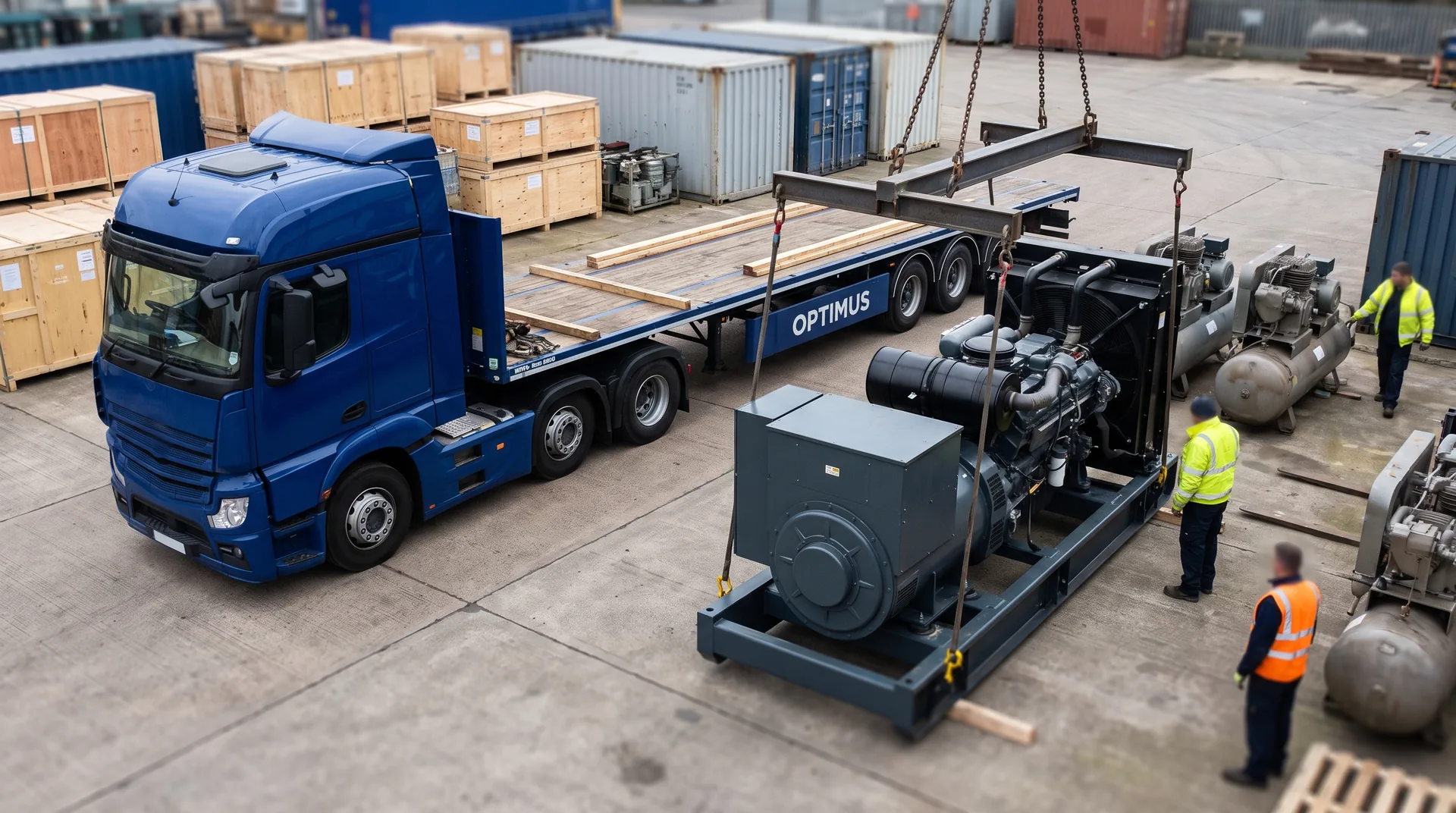
- The centre of gravity of a generator is not in the middle of its outline: the engine sits on one side, the alternator on the other, the tank under the frame. Weight distribution on the trailer is settled before the unit is set down, because correcting it means lifting again.
- A portable compressor has a drawbar and wheels, but that does not mean it may be towed behind a vehicle on a public road. Road approval is a separate matter and does not replace carriage on a trailer.
- The transport frame or skid under the unit is the best restraint point. Where the manufacturer has marked lashing points, we use only those; the calculation is covered in our article on cargo securing under EN 12195.
Site, office and welfare containers
A container bought at auction is two different loads depending on whether it has corner castings. An ISO container is lifted by the castings and secured with twistlocks, so the carriage is predictable. A site or office container without such castings is lifted by eyes in the frame, and its stiffness is entirely different: a lift in the wrong place bends the frame and the doors stop closing. We separately establish whether the container travels empty. Equipment left inside shifts on the road, its mass is invisible from outside and it can overturn the payload calculation.
Container height added to the height of the trailer deck is often the parameter that pushes a combination past the clearance. Trailer types and deck height differences are compared in our article on trailer types for the UK route.
Will such a unit travel in groupage
A small skid-mounted generator or a compressor on a pallet will fit into groupage, provided it can be set down stably, its dimensions and mass declared, and it can be secured so that it does not touch neighbouring goods. Non-palletised loads, meaning crates, frames and skid-mounted units, are described in our article on non-palletised groupage. A container and a large standby generator will not travel in groupage: they take the full width and need a dedicated truck. The line is practical rather than contractual and follows from how much room is left for everything else.
Customs paperwork
The export declaration is filed on the British side, the import one on the EU side, and the customs value rests on the price actually paid at auction. With technical equipment the authorities often probe the specification, so the unit data sheet, the nameplate and the serial number matter as much as the invoice. We arrange clearance working with our regular customs agencies on both sides of the Channel; documentary requirements for used equipment are set out in our article on importing used machinery from the UK.
Sources
- UNECE: ADR agreement on the international carriage of dangerous goods by road
- GOV.UK: moving dangerous goods
- GOV.UK: securing loads on HGVs and goods vehicles
Found a generator or container at a British auction? Send the lot number and yard address through the quote form and we will check the mass, the lifting points and the loading method. See also customs clearance.