British auctions sell front loaders as standalone lots, detached from whatever tractor they once served. Before you raise your hand, settle two questions: whether that model fits your machine, and whether the mounting frame is included, because it is frequently bid as a separate lot in the same sale. A loader on its own is heavy but compact, which makes it a very willing groupage load.
What you are actually buying: seven parts, not one
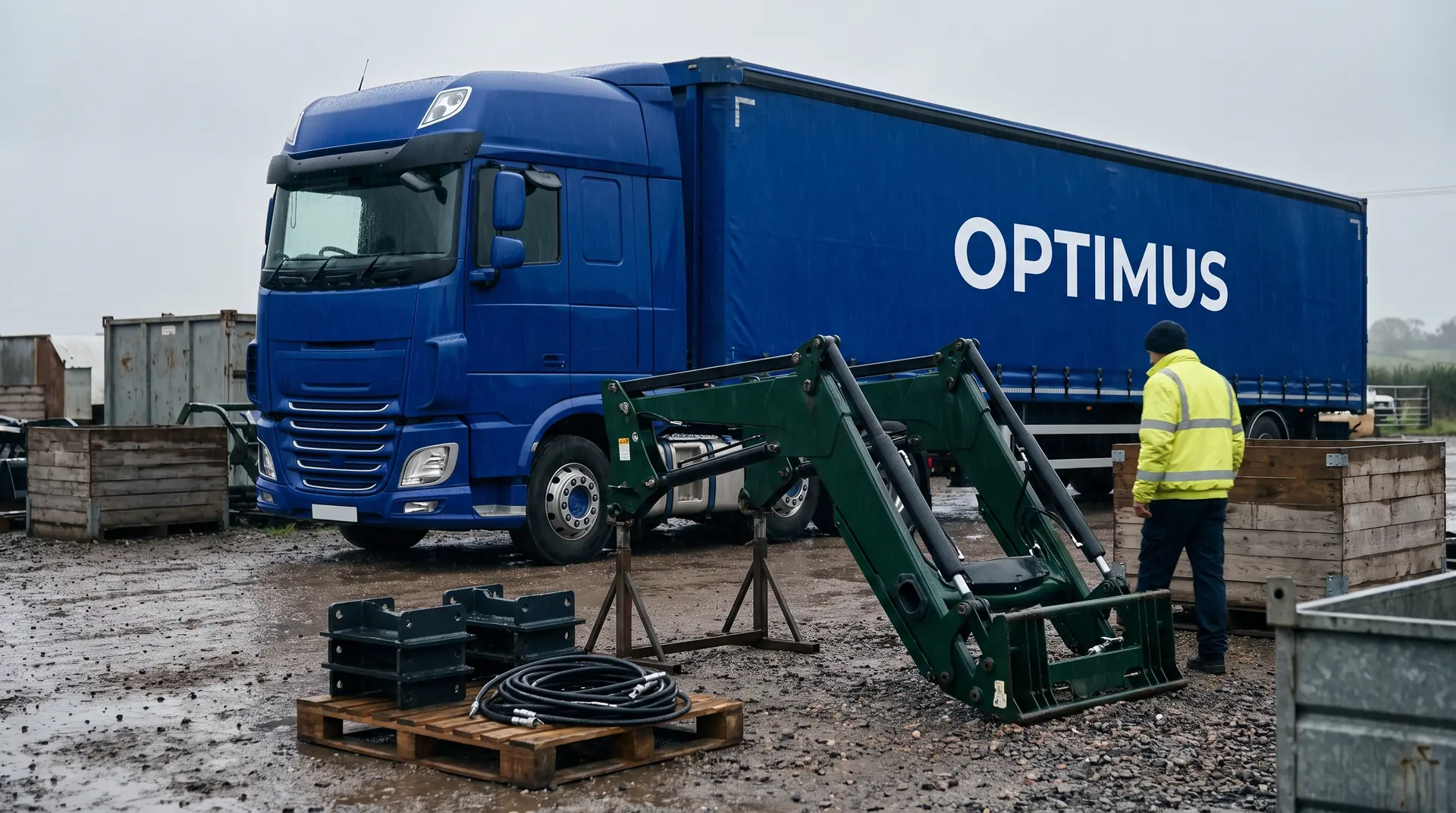
The catalogue shows a single entry, but a workable set means arms with rams, a carrier frame, brackets for the given tractor, an attachment coupler, hydraulic pipework with hoses, joystick controls for the cab and the working attachment itself. Missing any one of them turns a bargain into a project lasting months. Yard photographs rarely show what is lying on the pallet next to the arms, so ask for a full photographic record of the lot before bidding — how to request one is set out in our note on inspecting a machine before collection from the auction yard.
- The loader model number on the frame plate lets a dealer confirm the fit.
- Brackets are recognisable by shape: they suit one tractor range, not all of them.
- Attachment couplers follow several competing standards — a bucket off another machine may not fit.
- Hose sets are often cut during removal, so count the ends before you bid.
Arms down and propped, rams locked
A loader taken off its tractor travels in a position where nothing can drop. The arms go low and rest on transport legs or timber, so the weight passes into the floor instead of hanging on the piston rods. Lift and crowd rams get a mechanical lock, because seals that have worked for years leak and an arm can settle while the vehicle is moving. Any exposed rod is wrapped: a scratch on the chrome becomes a leak in the first week of use. How lashings are counted for a load with a high centre of gravity is covered in our piece on cargo securing under EN 12195.
Hydraulics, or the fight for a clean floor
Hoses disconnected in a yard almost always drip. Oil under a load is more than a mess: a wet floor costs a strap its grip, and a spreading patch can ruin a neighbour's cartons in a groupage consignment. As standard we cap the ends or wrap and tie them, and absorbent matting or heavy sheeting goes underneath. Where a reservoir or a valve block came off with the frame, they travel separately and labelled so they do not go astray. Between the United Kingdom and Poland a groupage load passes through two transhipments, so every loose part needs its own place and its own label.
- Hydraulic caps are sold in any British agricultural merchant if the yard has none.
- The joystick and control loom travel boxed, not loose on the frame.
- A photograph of the hose routing before removal saves hours during refitting.
Bucket and pallet forks are separate load items
Working attachments come off the coupler and travel beside the arms, since a mounted bucket adds height for no reason and gets in the way of securing. A bucket lies inverted on the floor or slides under the arms; pallet forks come off the carriage and are bundled. On paper they are separate things as well: they carry their own value and their own description in the declaration, and where they come from a different maker than the loader they may fall under a different tariff heading — how to establish it is explained in our guide to the CN and HS customs tariff code.
Why it makes such a good groupage load
A loader without a tractor is heavy but low and tightly packed — it takes little floor and never pushes the outfit into permit territory. Sending a dedicated vehicle for one therefore makes little sense: it waits for the next scheduled line departure and travels with other machinery from the same region. A dedicated outfit only becomes worthwhile above roughly twelve pallets, about a third of a trailer. Excavators and loaders from UK auctions are costed the same way, although their dimensions grow far more quickly.
When the loader travels with its tractor
If you buy a tractor with the loader still fitted, we normally take it off for the journey anyway. A mounted loader adds metres to the machine, raises the centre of gravity and blocks access to the tractor's front lashing points. Removed, it lies alongside on the same floor and the whole outfit stays within ordinary dimensions. Removal in the yard is quick provided the site makes a lifting machine available, which we agree when planning collection alongside the rest of the conditions described in our article on collecting and hauling tractors from the United Kingdom. A loader lives at the muck heap and in the yard, so manure and silage sit on the bucket and inside the arm sections; organic residue counts in plant health control exactly as soil does, and the procedure is set out in the article on farm machinery auctions in the United Kingdom.
Sources
- GOV.UK: load securing guidance for vehicle operators
- HSE: safety during loading and in transport operations
- PIORiN: plant health requirements for used agricultural equipment entering the European Union
Heading to a sale where the loader and the frame are two lots? Fill in our haulage quote form with both lot numbers and we will price them as a single load. Collection dates and removal arrangements are settled through the OPTIMUS TRANSPORT team, and the scope of agency work is described on our customs clearance page.