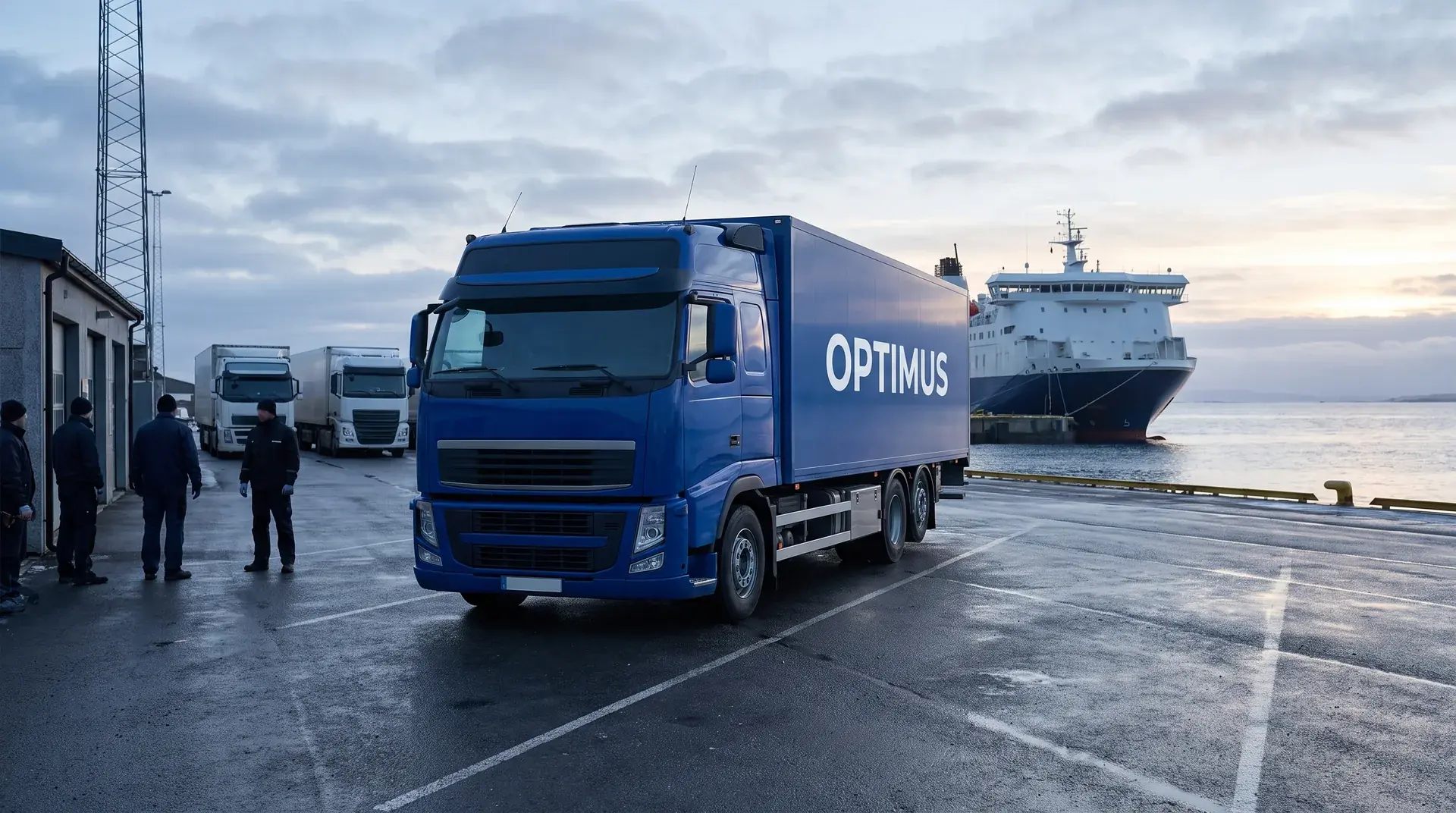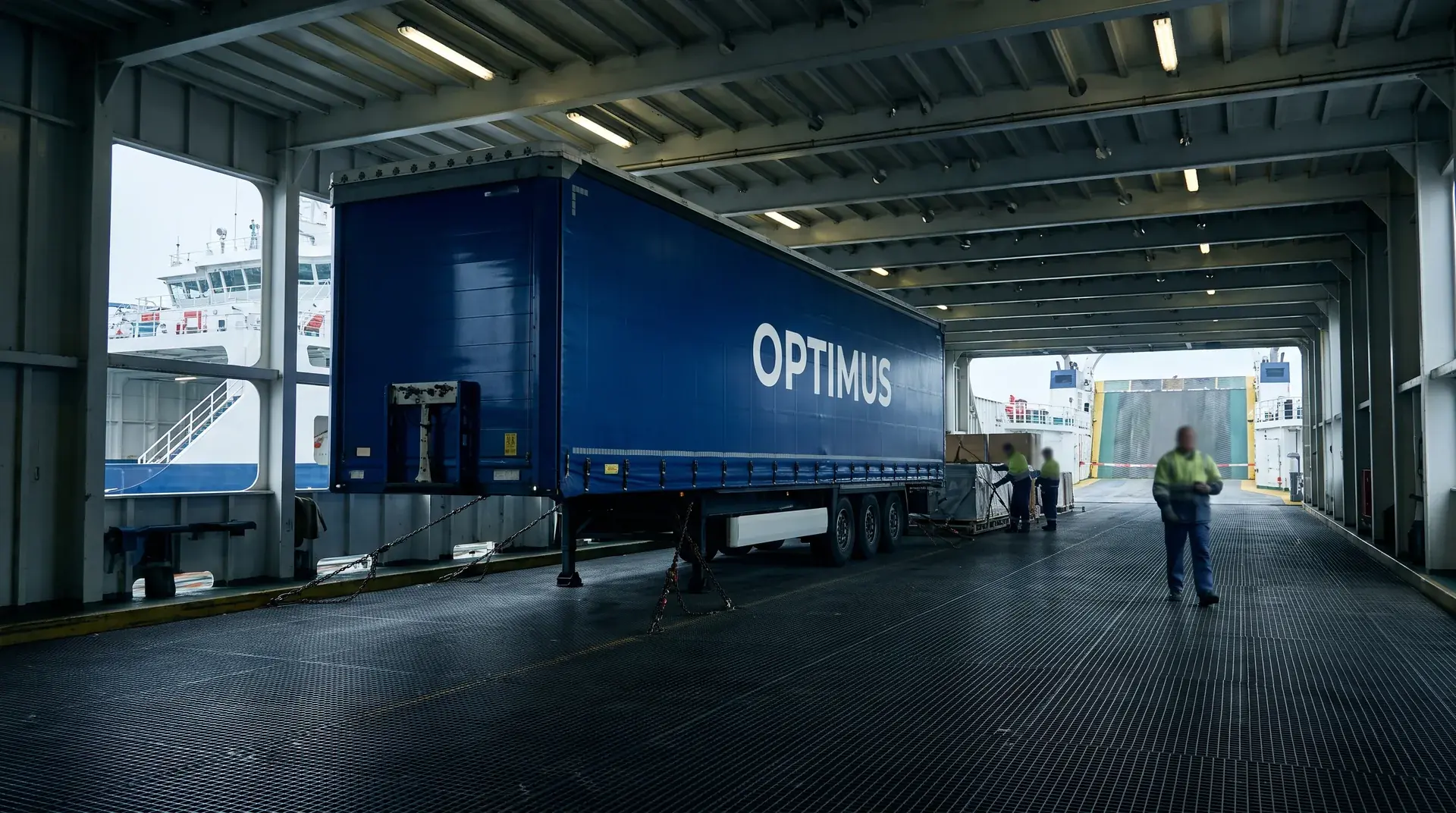
Mull is served by the CalMac ferry from Oban to Craignure; Iona is reached by a second, short crossing from Fionnphort at the western end of Mull. The key difference: vehicle access to Iona is restricted by a prohibition order with a permit system run by Argyll and Bute Council, so cargo for that island finishes its road journey on the Mull side.
How many crossings separate the mainland from Iona?
Two. Oban to Craignure on Mull, then Fionnphort to Iona. Between them lies a drive across the whole of Mull, much of it on single-track roads with passing places. Three legs, each with its own rhythm and its own constraints — which is why a delivery to Iona is not a Hebridean delivery plus a bit, but a separate planning exercise. The wider archipelago context is in our text on transport to the Hebrides.
Can a delivery vehicle drive onto Iona?
Vehicle traffic on Iona is governed by a prohibition introduced by Argyll and Bute Council together with a permit system — vehicles are not admitted as a matter of course, and permits are issued in limited cases, including vehicles ordinarily kept on the island by residents. For an outside carrier the consequence is simple: we do not assume our vehicle will cross. Cargo is handed over on the Mull side and the final leg is handled locally. We check the permit conditions with the issuing authority before accepting a job, rather than relying on how it once worked.
Which port serves Mull?
The main crossing runs from Oban to Craignure and is operated by CalMac. Oban is also the principal ferry hub of western Scotland — connections to smaller islands of the region leave from the same port. The run to Oban is planned within our deliveries to Glasgow and western Scotland. Commercial vehicle space is booked in advance; the operator itself sets out the advance-booking requirement, and we collect the procedural detail in our article on booking freight on CalMac ferries.
Where does the truck from Poland actually stop?
That is the central question here, and the answer depends on the destination address. For a consignee on Mull — in Tobermory, Craignure or Bunessan — the vehicle can reach the door, provided its dimensions fit the route and the local roads. For a consignee on Iona the vehicle stops at Fionnphort and the goods continue without it. In both cases the decision is taken before loading in Poland, because it shapes the palletisation: cargo that will be carried by hand or moved on a small boat has to be broken into liftable pieces that survive repeated handling. How we choose the vehicle for the last leg is described in our text on the last leg on the island.
Single-track roads on Mull
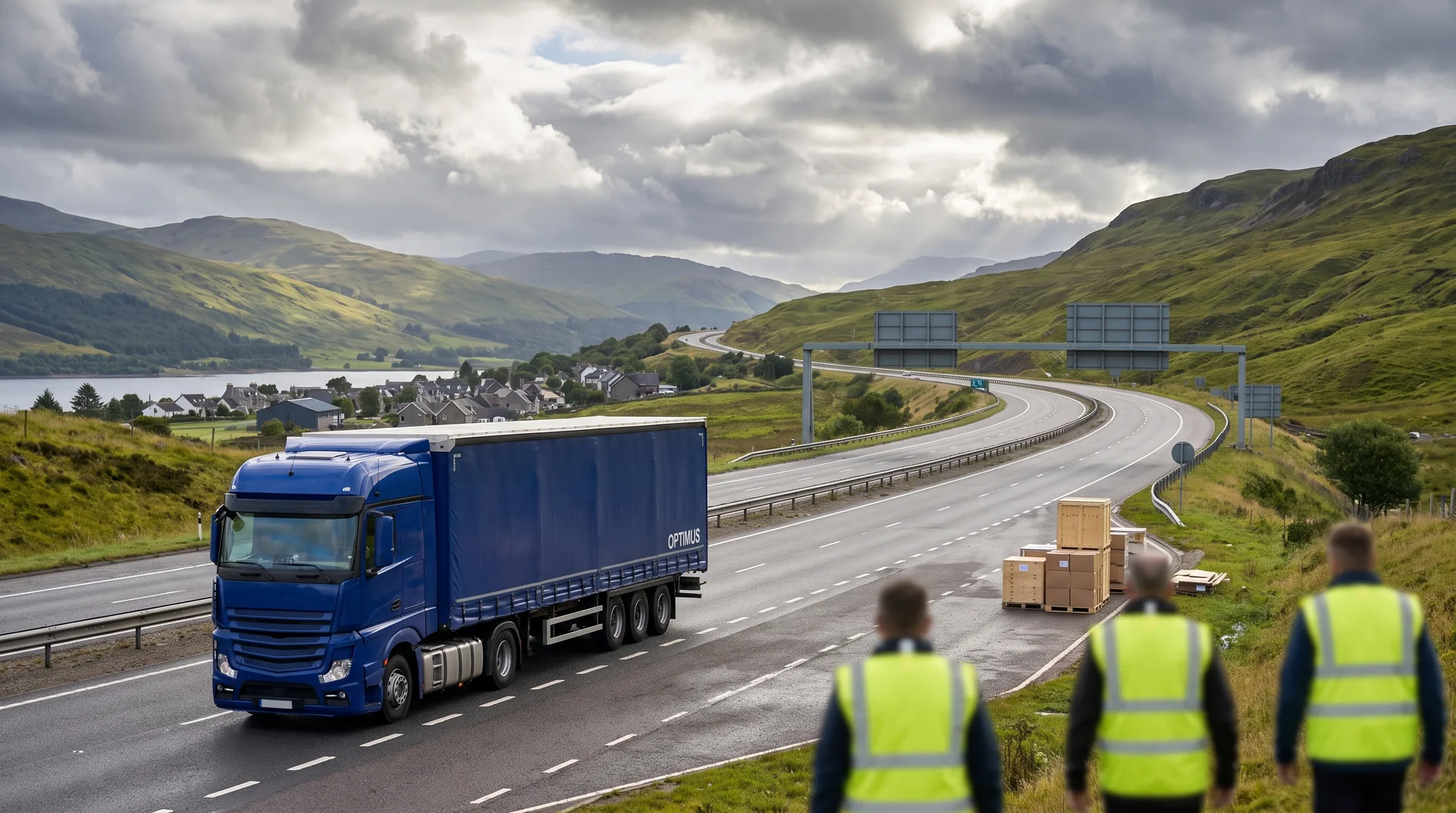
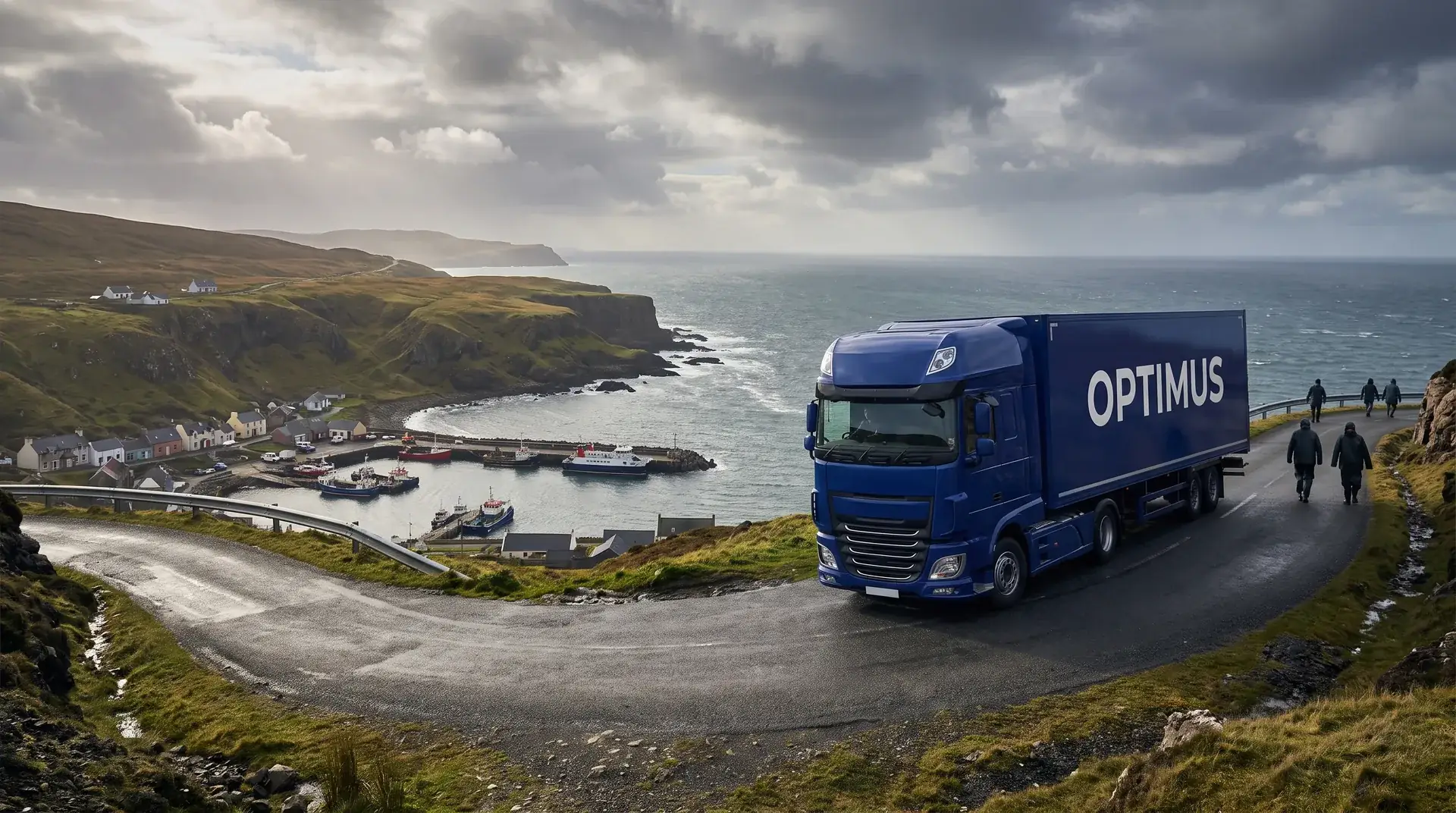
Much of the island road network is single-track with passing places. That is not a legal limit but a physical one: a long unit moves slowly, manoeuvres badly, and reverses to the nearest passing place when it meets a bus or a local lorry. The consequence is real extra time on the island and a frequent decision to use a smaller vehicle for the final leg, even where the unit would in theory fit the ferry. Trailer choice for a route is discussed in tautliner, mega or curtainsider.
Who takes over the goods if the vehicle cannot cross?
The handover must be written into the job before the goods move — otherwise it ends in an argument about who is responsible for cargo standing on a quay. We fix three things: the handover point, the receiving party and the moment responsibility passes. We document the handover exactly as an ordinary unloading, with a signature and photographs of the cargo condition. That is not a formality: where an extra sea link is involved, documented condition at the handover point is the only hard evidence available. The liability context is set out in our article on carrier liability under CMR.
How many days should be added for a Mull delivery?
We do not quote a fixed number, because it depends on sailing availability and on whether the delivery ends on Mull or continues to Iona. We do state the principle: every additional sea leg is a separate time window that cannot be recovered by driving faster. With two crossings the risk of a schedule slipping grows non-linearly — one delay is enough to miss the next connection. So for Iona we plan with visible margin and say so when quoting. The buffer mechanics are unpacked in our text on the time buffer for island deliveries.
Sources
- Argyll and Bute Council: Iona vehicle permit
- CalMac: routes and ports (Oban-Craignure, Fionnphort-Iona)
Have a consignee on Mull or Iona? Describe the cargo and address in the quote form and we will break the delivery into legs with a defined handover point. Our other islands are listed on the island transport page.