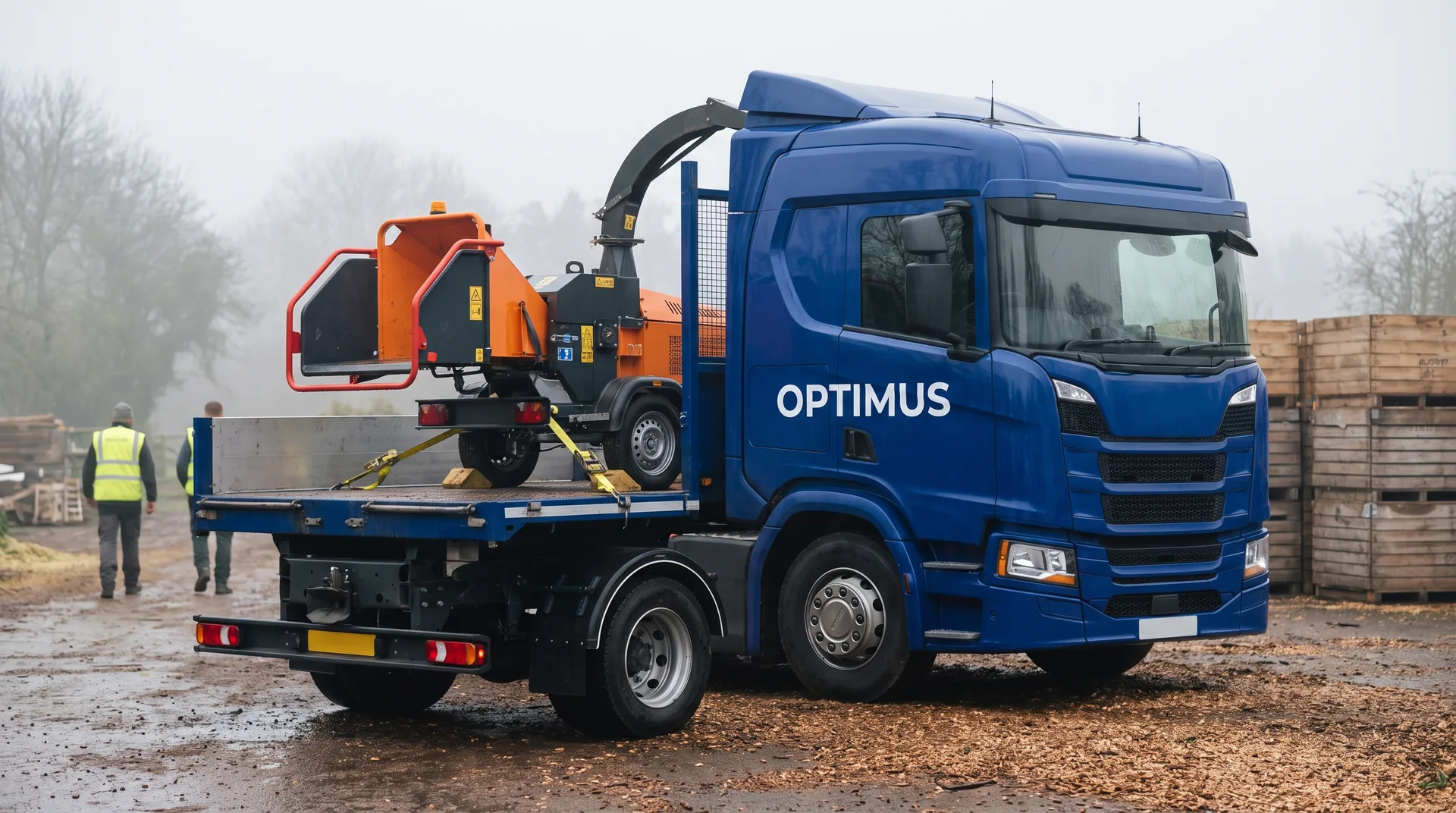
A wood chipper bought at a British arboricultural auction is a towed machine, but it crosses the Channel as cargo on a trailer deck rather than on a towball. A trailer with no valid paperwork, an overrun brake of unknown condition and tyres that have sat on a yard for a season is trouble at the first roadside check. On the deck the problem disappears: the drawbar is propped, hopper and chute fold away, and the machine becomes an ordinary line on the consignment note.
Why the chipper does not travel on a towball
Tree care equipment leaves auctions in batches, because the same kinds of owner replace it on a cycle: arb contractors at the end of a contract, highways authorities and parks departments after a tender for new kit. One yard can therefore hold several chippers of different ages standing side by side. The buyer normally asks the same first question: it is a trailer, so why not hitch it behind a vehicle and drive it home?
Because that is not the easy option. The machine leaves a market where it ran under British rules, and its documentation is usually an auction listing and a nameplate rather than a trailer registration document. On top of that sits a mechanical condition nobody declares: overrun brake, hub bearings, lighting, electrical socket. Auction sales happen on an as-is basis, so each of those items may be sound or not, and you find out while travelling.
On the deck none of those questions affects the journey. The chipper is cargo: what counts is mass, the folded dimension and whether it can be secured properly. Everything else you check calmly in Poland, before the first start-up. It also removes the question of who drives an unfamiliar outfit, because we do not organise journeys made under the buyer's own wheels at all.
Drum or disc: what folds before loading
Disc chippers use a bladed disc as the rotor and usually have a compact body, drum machines work with a rotating drum and tend to be heavier for the same infeed diameter. For haulage the difference comes down to how mass sits on the drawbar and how far the hopper reaches beyond the frame. Both are checked on site, because a catalogue describes a factory-new machine, not the example with a welded-on jerrycan bracket and a replaced drawbar.
- The infeed hopper, on most machines folding upwards or sideways, must have its own mechanical lock once folded, not just the working catch.
- Feed rollers secured against rotation, so that vibration on the road does not turn them.
- The safety bar and emergency stop around the hopper, inspected before loading, because protruding levers are easy to tear off while manoeuvring on the yard.
- The discharge chute with its deflector, turned and lowered, since it usually dictates the overall height of the machine as it stands on the deck.
- Belt and clutch guards, and if one is missing you record it in the collection paperwork so there is no later argument about transit damage.
Drawbar, stands and jockey wheel
The biggest risk with a chipper is not the machine itself but everything that sticks out of it. A drawbar with a hitch is a long lever: stood upright it adds height, laid flat it eats loading length and can slide under the neighbouring consignment. The driver chooses the position after looking at the machine, but it always ends the same way, with the drawbar supported and lashed rather than left hanging on its own transport catch.
The jockey wheel and side stands are wound down into their travelling position and pinned. Chocks go under the road wheels, and lashings are attached to the frame points named by the manufacturer, not to mudguards, guards or the drawbar. How lashings are selected is covered separately in the article on cargo securing under EN 12195, and the point specific to a chipper is that a machine on pneumatic tyres settles over the first few miles, so lashing tension has to be corrected at the first stop.
The fuel tank is drained before loading, as with any petrol or diesel plant. The battery is disconnected and secured, hydraulic oil stays in the system but must not be leaking onto the floor under the machine. If the chipper weeps, you say so when ordering, because it then needs a tray or sheeting and a different position in the outfit.
Chip in the hopper and timber on the deck
A chipper that worked until auction day carries chip, bark and leaf residue in the hopper and the discharge duct. That is plant material, and equipment used in forestry work is subject to border phytosanitary control on entry to the European Union. I am not repeating the procedure here, it is set out step by step in the article on British farm machinery auctions. What matters for a chipper is where that material sits: under the feed rollers, in the elbow of the chute, inside the rotor housing and in the chassis around the springs. Pressure washing the bodywork achieves nothing until the guards come off, and that takes longer than the washing itself.
The second thread is timber that sometimes travels with the machine: chocks, bearers, a blade box, the pallet underneath. Wooden packaging material carries its own requirements and its own mark, described in the article on the ISPM 15 standard for wooden pallets. The simplest answer is this: if you do not have to carry somebody else's bearers, do not carry them.
The rest of the yard travels on the same vehicle
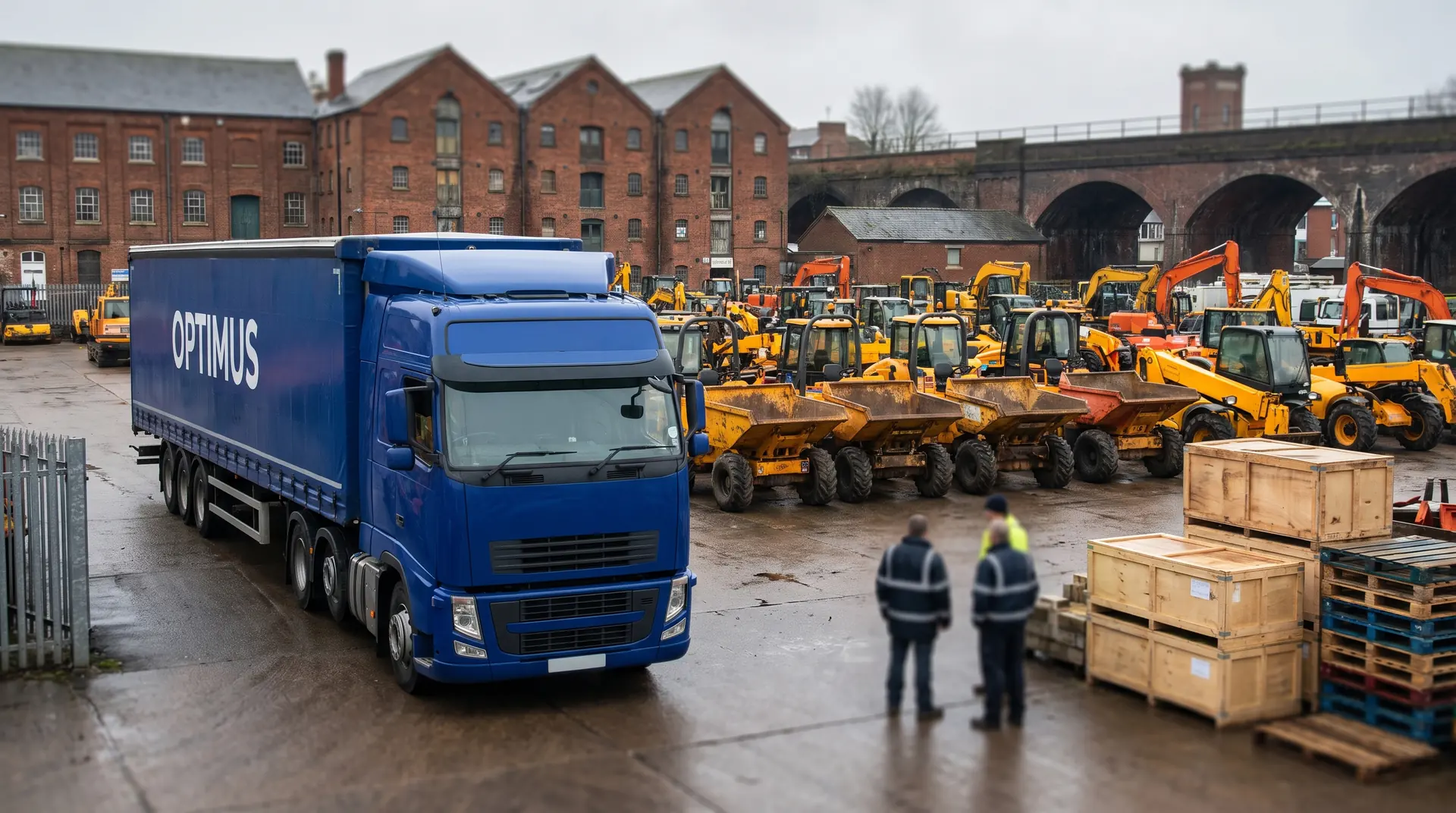
A disposal sale from an arb business rarely ends with a single machine. Next to the chipper you normally find stump grinders, tracked chippers, saws, blade trailers and access platforms for work in the canopy. Those platforms are a different haulage category, covered in the article on moving forklifts, scissor lifts and boom lifts. A set bought at one yard is worth taking together, because you pay once for the collection run and once for the customs entry.
The chipper on its own is groupage cargo: it goes onto a consolidated vehicle that waits for the next scheduled line departure, and on the route it passes through two transhipments, at the warehouse in Milton Keynes and at the base in Kielce. Once the consignment grows beyond about twelve pallets, the arithmetic starts to favour a dedicated vehicle and the equipment travels without transhipment. Customs entries on both sides are handled in cooperation with our regular customs agencies.
Sources
- GOV.UK: rules on securing loads on HGVs and goods vehicles
- PIORiN: phytosanitary conditions for machinery used in agriculture and forestry
- IPPC: the ISPM standards, including requirements covering timber
Have you got the lot number and the yard address? Send them through the transport quotation form and we will tell you whether the chipper fits the next consolidated departure or whether it is better to wait for the full set from that sale. Questions about entries and paperwork go to the customs clearance page or straight to the operations team.