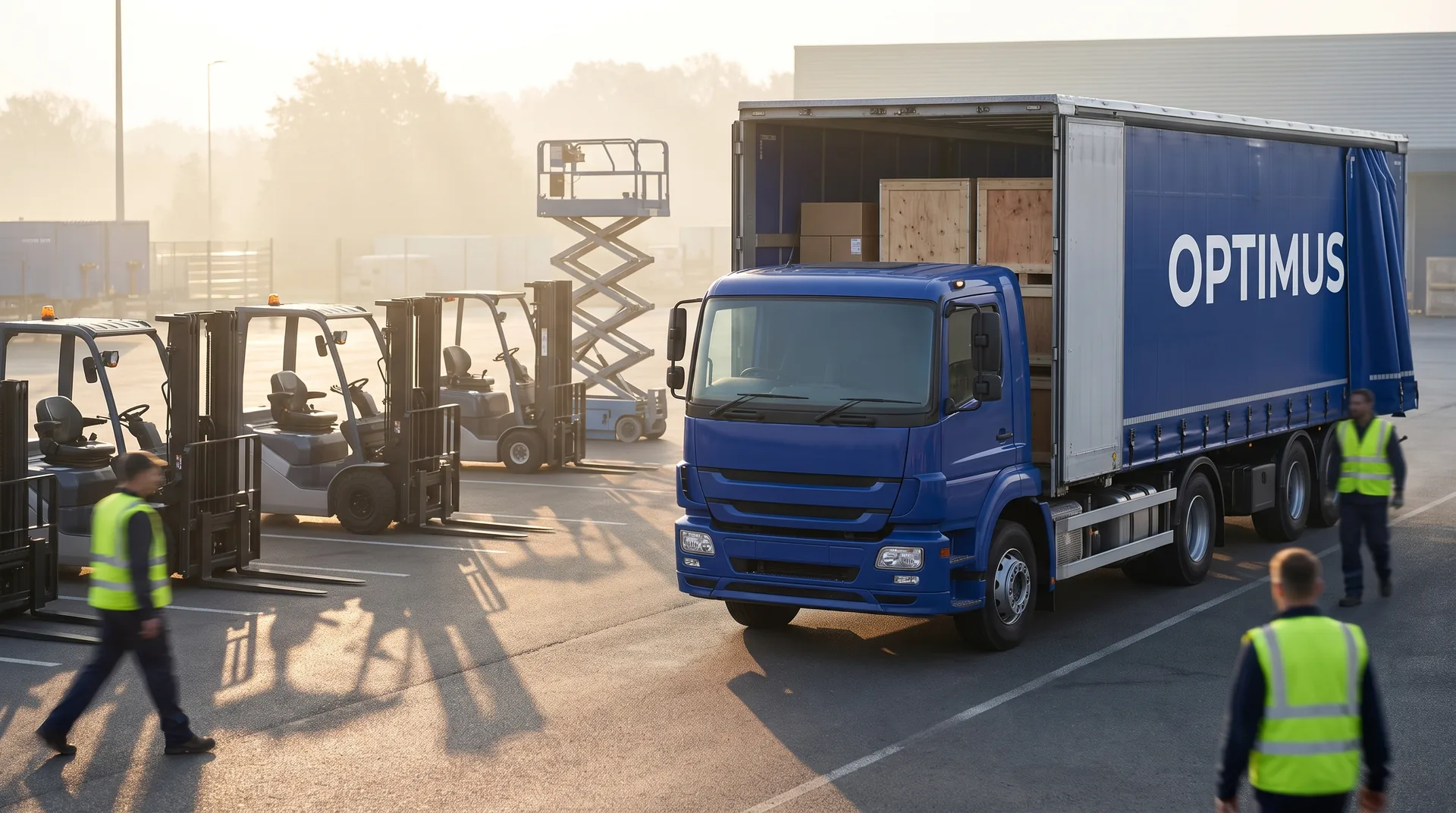
A forklift, a scissor lift and a boom lift look similar in an auction listing and behave completely differently in transport. Three things decide: the drive and battery type, the height of the machine in its travel position, and whether it can climb the ramps on its own. We settle all three before quoting, because each of them can change the vehicle.
Drive and battery: the first thing to check
An electric forklift has a traction battery that is often heavier than the rest of the machine and serves as its counterweight. A lead-acid battery is a vessel holding electrolyte, so the carriage position, the tightness of the cell caps and the protection of the terminals all matter. A lithium-ion battery falls under separate requirements whose scope is read off the cell plate rather than guessed from the casing. An LPG truck has a cylinder that is removed before carriage or secured according to the manual. A diesel truck has a fuel tank and brings back the question we ask of every machine: how much is left in it and what follows for the dangerous goods rules. The answer comes from the regulations, not from assumption; the basics are collected in our article on ADR fundamentals.
Height in the travel position
A forklift mast does not always fold. Two- and three-stage masts have a fixed structural height with the forks lowered, and that is the figure that goes into the calculation, not the lift height quoted in the listing. A scissor lift has a stowed height given in its machine sheet, usually with the guardrails folded or removed, and the difference between folded and raised rails is larger than people expect. A truck-mounted boom lift is already a vehicle: either it drives itself, or it goes onto a recovery truck, and then the height is the bed of that truck plus the height of the cab.
Combination height is the parameter that most often pushes a consignment out of the standard bracket, and at the same time the easiest one to reduce: taking off the guardrails, the carriage, the fork extensions or the beacon takes a quarter of an hour. Trailer types and deck heights are compared in our article on trailer types for the UK route.
Getting onto the vehicle
- A working truck climbs the ramps, but it has low ground clearance and a short wheelbase, so the ramp angle constrains it more sharply than it does an excavator. A forklift can ground out on the edge of the deck even though it drives on it.
- A scissor lift has a transport travel mode with limited speed and normally requires the platform to be fully lowered. Many machines block travel with the platform raised, and rightly so.
- A machine that does not run comes aboard on a winch or by crane, from the points the manufacturer specifies. Lifting a boom lift by the basket or a forklift by the mast is the quickest route to damage that stays invisible until the first service.
- Solid, polyurethane and cushion tyres do not absorb anything. On an uneven yard the machine bounces, and coming off a ramp it can slide sideways, which is why firm level ground is a condition rather than a preference.
Which option works in a given yard is settled before dispatch; handling equipment and how it is chosen are covered in our article on loading a machine at the auction yard.
Securing: what must never serve as a lashing point
Manufacturers of forklifts and lifts mark lashing points on the frame, usually four of them. Everything else is ruled out even where it is convenient: the mast, the carriage, the rams, the basket rails, the guards and the service handles are not load-bearing for lashings. Forks come down to the deck and are secured against sliding on the carriage, scissor arms are blocked where the manufacturer provided a lock, and the wheels are chocked. Strap tension is checked again after the first few kilometres, because solid tyres settle less than pneumatic ones but the machine still beds into the lashings. The calculation is covered in our article on cargo securing under EN 12195, and whether the truck travels alone or beside other goods is discussed in our piece on non-palletised groupage.
What awaits the machine after unloading in Poland
Equipment for lifting loads and people is subject to technical inspection supervision in Poland, and the scope of examinations, required documents and formalities is set by the Office of Technical Inspection. Buyers check this with that office before bidding, because how quickly the machine returns to work depends on the completeness of its documentation. We do not handle that side: we arrange collection, haulage and clearance, and we do not deal with putting the equipment into service or with servicing it. Marking and technical documentation requirements for machines from the British market are collected in our article on importing used machinery from the UK.
Sources
- Office of Technical Inspection: equipment subject to supervision
- UNECE: ADR agreement on the international carriage of dangerous goods by road
- GOV.UK: securing loads on HGVs and goods vehicles
Bidding on a forklift or a lift in the UK? Send the model, drive type and yard address through the quote form and we will check the travel height and the loading method. Clearance is arranged as part of our customs service.