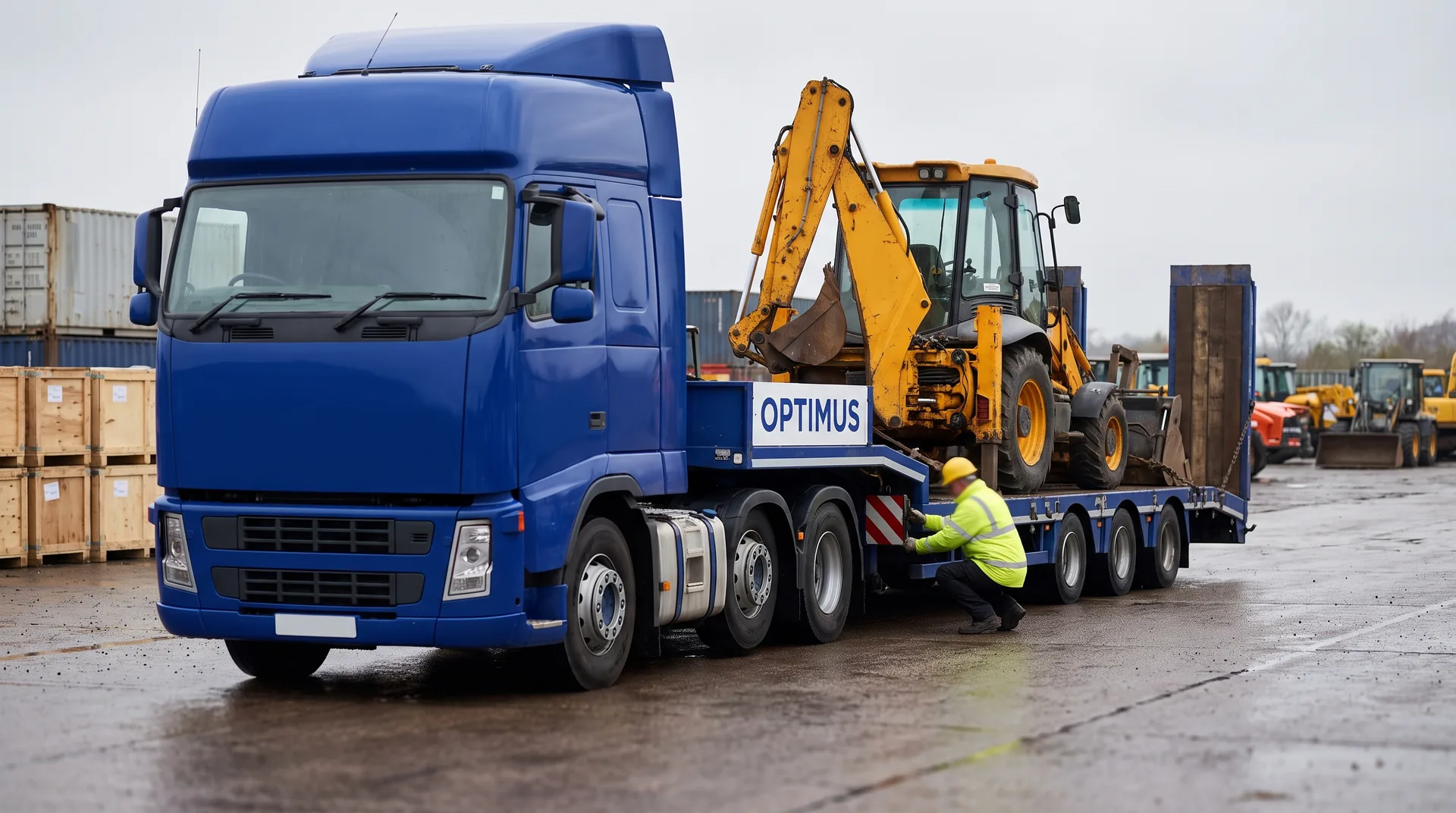
A backhoe loader travels on a trailer in transport position, meaning the backhoe boom folded and locked over the rear axle and the loader bucket resting on the deck. In that configuration the machine usually stays within normal limits on a standard low loader, but the height over the cab has to be confirmed by measurement, because it differs between versions and depends on what sits on the roof.
Two attachments, two different problems
The machine carries a loader bucket at the front and a backhoe at the rear, and each of them governs a different dimension. The bucket sets the width: on many versions it is wider than the body and it alone decides whether the movement stays within normal limits. Taking it off and laying it beside the machine on the deck can bring the figure back within limits, but it turns the bucket into a separate line on the loading list and on the customs declaration. A four in one bucket also has moving jaws that must be closed and secured.
The backhoe, in turn, governs length and height. Folded and seated in its transport latch it lies low, but if the latch is worn or the pin missing the boom works on the road and knocks against the guards. Checking that latch belongs to the inspection before collection, not to the driver who brings the vehicle.
Height, or what sits on the roof
Backhoe loaders vary in height more than the shared silhouette suggests. An air conditioned cab, a beacon bar, a warning light, a roof vent and roof handles each add centimetres, and once the machine stands on a deck every one of them counts the same. We measure with a tape from the ground to the highest point of the machine standing on the yard, then add the deck height of the trailer that will arrive. If the result exceeds the limit, before applying for a permit we check what unbolts: the beacon bar and the vent usually do, the cab does not. Permit rules are set out in our piece on excavators and loaders from UK auctions.
Loading and locks
- A working machine climbs the ramps on its own wheels, nose or tail first depending on the weight distribution, which is settled before it goes up, not after.
- Rear stabilisers are raised fully and locked; lowered, they catch the deck edge on the way up.
- The front axle lock and the steering lock, where fitted, go to the transport setting given in the manual.
- An extending dipper is retracted fully and locked, because extended it works on the ram for the whole run.
- Auxiliary hydraulics, if the machine has breaker couplings, are closed with caps. That is not cosmetic: an open coupling drips oil onto the deck.
Lashing
A machine on four rubber tyres needs chocks at each axle and lashings hooked into the points marked by the maker. It is tempting to strap through the backhoe boom or the loader arms because they are easy to reach; those parts are built to carry working loads, not to hold the machine against shifting. Tension is checked after the first leg, because tyres deflect under pressure. The method for selecting lashings is collected in the article on cargo securing under EN 12195.
Fluids, fuel and battery
A backhoe loader has an extensive hydraulic system with many hoses routed along the boom, so leaks are commoner here than on simpler machines. We check rams, couplings and hoses before loading, and a machine with a visible leak is positioned so that nothing drips onto other people goods. The fuel level is agreed before collection, because the fuel type, tank construction and contents decide whether the movement falls under dangerous goods rules. The battery is disconnected, the terminals protected, the keys travel with the paperwork and the cab is locked.
Soil in the undercarriage and the border
This machine works in soil by nature, and on farm or forestry ground it brings soil in the tread, in the bucket and behind the panels. Bringing equipment used for agricultural or forestry purposes into the Union means meeting the phytosanitary conditions, that is a notification in TRACES NT and a CHED-PP certificate, with the importer entered in the register kept by the Polish plant health service. We describe the whole thing under farm machinery auctions in the UK, so here one practical rule is enough: wash the machine on the yard before loading, whatever role it played.
Groupage or a vehicle of its own
A backhoe loader fills the deck and travels as a dedicated load. Anything added is limited to attachments from the same sale laid beside it: buckets, forks, a breaker. If you bought the machine together with small plant, splitting the order is often cheaper, because small plant fits a consolidated vehicle waiting for the next scheduled line departure. The data set needed for a binding rate is listed in the piece on a transport quote before the auction.
Sources
- GOV.UK: securing loads on HGVs and goods vehicles
- GDDKiA: permits for abnormal vehicle movements
- PIORiN: phytosanitary conditions for machinery used for agricultural or forestry purposes
Won a machine and have a collection deadline at the yard? Send the model, serial number and address through the quote form and we will come back with the trailer type and the list of things to do on site. See also customs clearance and collection deadlines at the yard. See also: wheel loader transport from the UK.