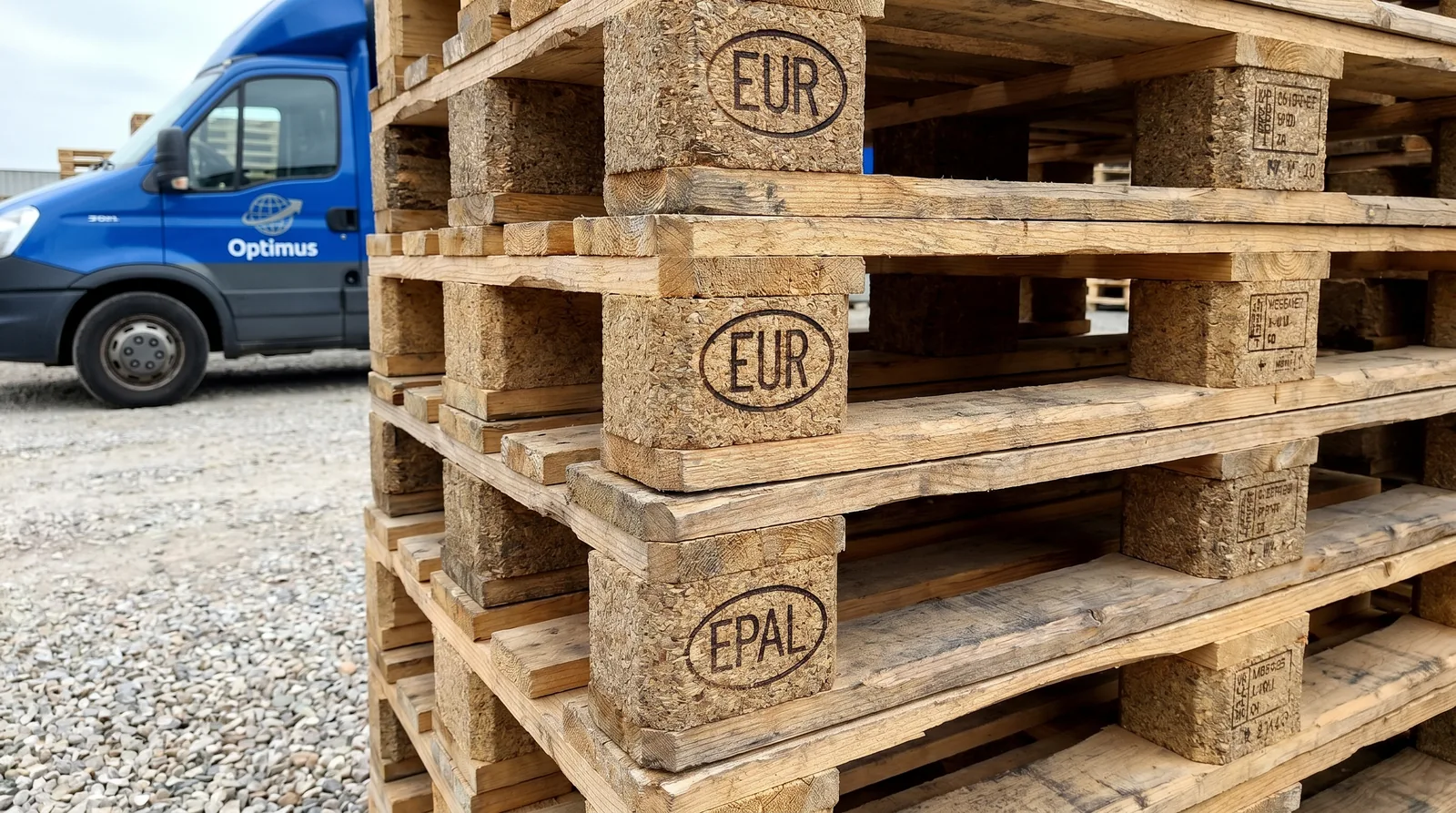
A euro pallet to the EPAL standard measures 1200 by 800 millimetres with a pallet height of 144 millimetres, weighs around 25 kilograms and carries branded marks burnt into the corner blocks. Its practical value comes from repeatability and from the exchange system: a serviceable pallet stays in circulation, a damaged one drops out.
Dimensions, construction and markings
The euro pallet is a four-way entry carrier measuring 1200 by 800 millimetres externally. The pallet itself is 144 millimetres high and a new one weighs around 25 kilograms, rising once it absorbs moisture. Construction is based on deck boards and blocks, and identification marks are burnt into the corner blocks: the EPAL mark, licence markings and evidence of phytosanitary treatment. Missing or illegible marks exclude a pallet from exchange even if it is physically sound. We compare it with other carriers in our text on the euro pallet and the industrial pallet.
When a pallet is still exchangeable, and when it is not
The acceptance criteria are set by EPAL and are technical rather than discretionary. Disqualifying faults include a missing or broken board, a board cracked across its full width, a block broken out or damaged enough to expose nail heads, protruding nails that could damage goods, components replaced with non-standard parts, and contamination making the pallet unfit for food. A pallet greyed by sun can still be sound; a pallet with one broken outer board is not. It is worth checking the current criteria at source, because they decide arguments at the ramp.
How exchange works, and where disputes come from
The idea is simple: at unloading the consignee returns as many pallets in similar condition as arrived with the goods. In practice settlement drifts for several reasons. The consignee has no pallets to exchange and issues a pallet note that then has to be redeemed. Returned pallets are in worse condition than those delivered and the driver refuses them. Pallets leave Poland as EPAL and come back unbranded. So on UK traffic we agree the rules in advance: one-for-one exchange, a pallet note, or settlement by value. Fixing that before loading is far easier than negotiating by phone while a driver stands at the ramp.
Exchange with the UK works differently from within the EU
On the continent the exchange system is dense and pallets circulate in a closed loop. On UK traffic that loop is looser, because carriers of other dimensions are common there and some receivers simply do not operate exchange. The practical consequence: pallets sent to the UK often do not come back, so they either go into the cost of the shipment or you deliberately use a one-way carrier. Retail deliveries add the receiver's own standards, covered in our text on UK retail pallet requirements.
Timber and phytosanitary requirements
Wooden packaging moving between the EU and the United Kingdom is subject to phytosanitary requirements based on the ISPM 15 standard, meaning heat treatment and appropriate marking. Wooden EPAL pallets fall within that, and a pallet without correct marking can hold up a consignment. This is a documentary rather than a quality issue, which is why it surprises senders whose pallets look perfectly fine. We develop the subject in our text on ISPM 15 requirements.
How many pallets fit on a vehicle and how to count them
On a standard trailer euro pallets stand in two rows along the floor, and the count depends on the length of the load space and on whether the goods can be double stacked. Double stacking is often the only way to use a vehicle sensibly with light goods, but it needs a stable bottom pallet and goods that will take the load. The arithmetic is broken down in our texts on trailer capacity and on double stacking, and conversion to loading metres in the article on loading metres.
Repair rather than disposal
A pallet damaged in transit is not automatically firewood. Replacing a board or a block at a licensed workshop returns the carrier to circulation, and across larger volumes that is a real saving. At our Milton Keynes warehouse we straighten and rebuild pallets while re-stacking goods, covered in our text on damaged pallet repair. How to build a pallet that survives the route is broken down in our article on securing a pallet for export.
Sources
Planning a palletised shipment to the UK and want the exchange rules settled before loading? Describe the load through the quote form and we will agree carriers, stacking and pallet settlement. Regular departures are described on the groupage LTL page.