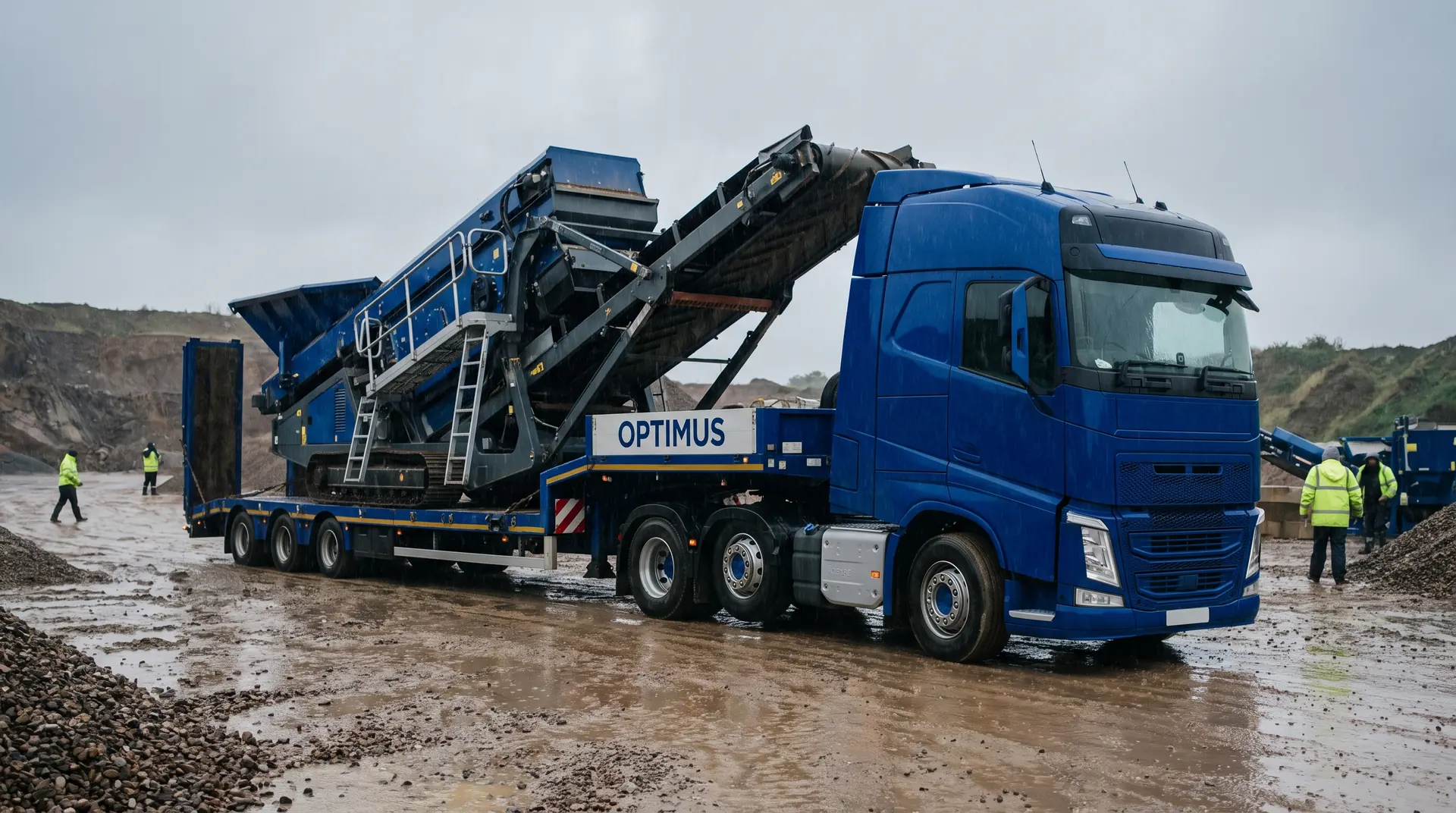
Once its belts are folded and its legs raised, a mobile screener is shorter and narrower, but the height of the screen deck and the supporting structure stays large, so the movement usually falls outside normal limits anyway. On top of that its weight is spread over a wide area, which changes how it is positioned on the trailer. The result: its own vehicle, its own permit, its own date.
Why it does not travel together
It is tempting to treat a set bought in one lot as one transport order. Physics says otherwise: each of these machines on its own uses up the dimension or weight limit for a single vehicle, so they do not stand side by side on a deck. Two machines mean two vehicles, two sets of permits and two dates, even if collection happens on the same day. They appear as two lines in the quote and have to be planned that way to avoid running into storage charges at the yard.
The exception is small trommel screeners on towed chassis: those sometimes stay within limits and travel with other equipment. Measurement decides that, not the class of machine.
What folds before the road
- Discharge belts and the oversize belt are folded to the transport position and mechanical locks fitted. A holding ram is not a lock.
- Legs and supports are retracted inside the outline of the machine and secured against creeping out.
- The screen deck and access flaps are closed and latched; loose screens in the deck move at every bump.
- The hopper is emptied and swept, and material left on the belts is removed, because it spills out en route.
- Belt guards and handrails, if removable and projecting beyond the outline, travel separately, laid flat.
Lifting and positioning on the deck
A screener carries its weight across a wide area with a high screen deck, so its centre of gravity is higher than the silhouette suggests. When craning we use only the points the maker specifies, and before swinging over the trailer we do a trial lift of a few centimetres to see whether the load hangs level. The position on the deck is settled before it is lowered, because correcting the placement of a machine this size means repeating the whole operation. The lifting and winching options are described in the piece on loading a machine at the auction yard, and the lashing rules in the article on cargo securing under EN 12195.
Permits and planning the date
Permit categories, issuing authorities and processing times are published by GDDKiA, and the British notification side is described in the article on oversized transport to the UK. With machines bought as a set it is worth fixing the removal order straight away: which machine leaves first, when the second follows and whether the yard will hold the second without charge. Collection deadlines and charges are set out in the piece on collection deadlines at the auction yard.
Fluids, fuel and battery
A screener driven by a combustion engine has a fuel tank and a hydraulic pack, while electric versions need a check on what will power them after unloading. Before carriage we check rams and hoses for tightness, and the fuel level is agreed with the yard, because fuel type and tank construction decide whether the movement falls under dangerous goods rules. The battery is disconnected, the terminals protected, and remotes and keys travel with the paperwork.
Dust and cleaning
Screens, belt channels and the hopper hold a surprising amount of material, and all of it spills out on the road. Emptying and sweeping the machine on the yard before loading is part of preparing it for carriage, not cosmetics. If the equipment has worked on agricultural or forestry ground, bringing it into the Union requires the phytosanitary conditions to be met: a notification in TRACES NT, a CHED-PP certificate and the importer entered in the register kept by the Polish plant health service. We describe the procedure under farm machinery auctions in the UK.
Sources
- GDDKiA: permits for abnormal vehicle movements
- GOV.UK: ESDAL and notifying abnormal loads
- HSE: workplace transport safety on yards and sites
Buying a set of machines from one yard and want the removal planned? Send the lot listings, transport dimensions and address through the quote form. See also oversized loads and our guide to UK machinery auctions. From the same category: a hydraulic breaker and excavator attachments.