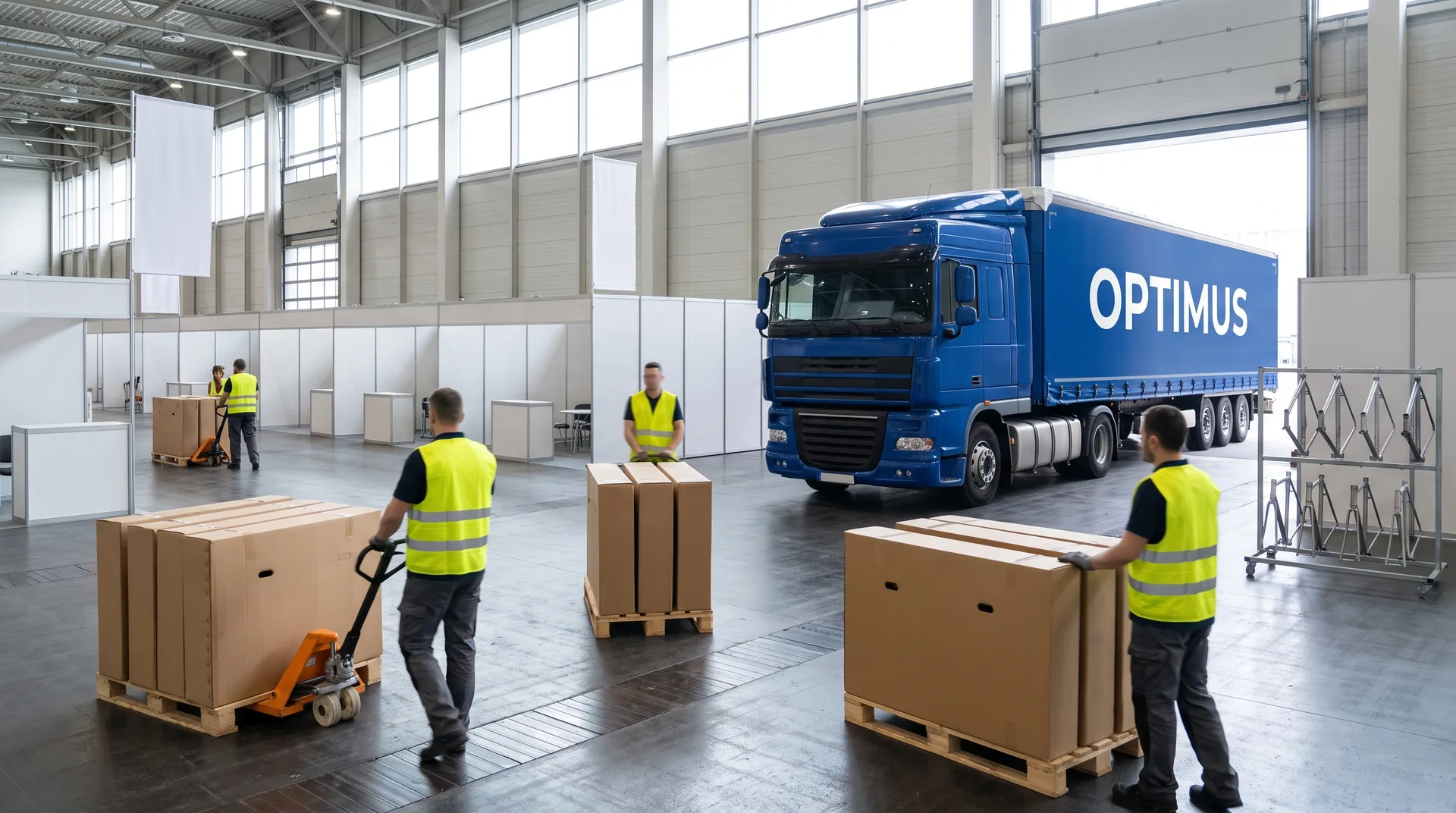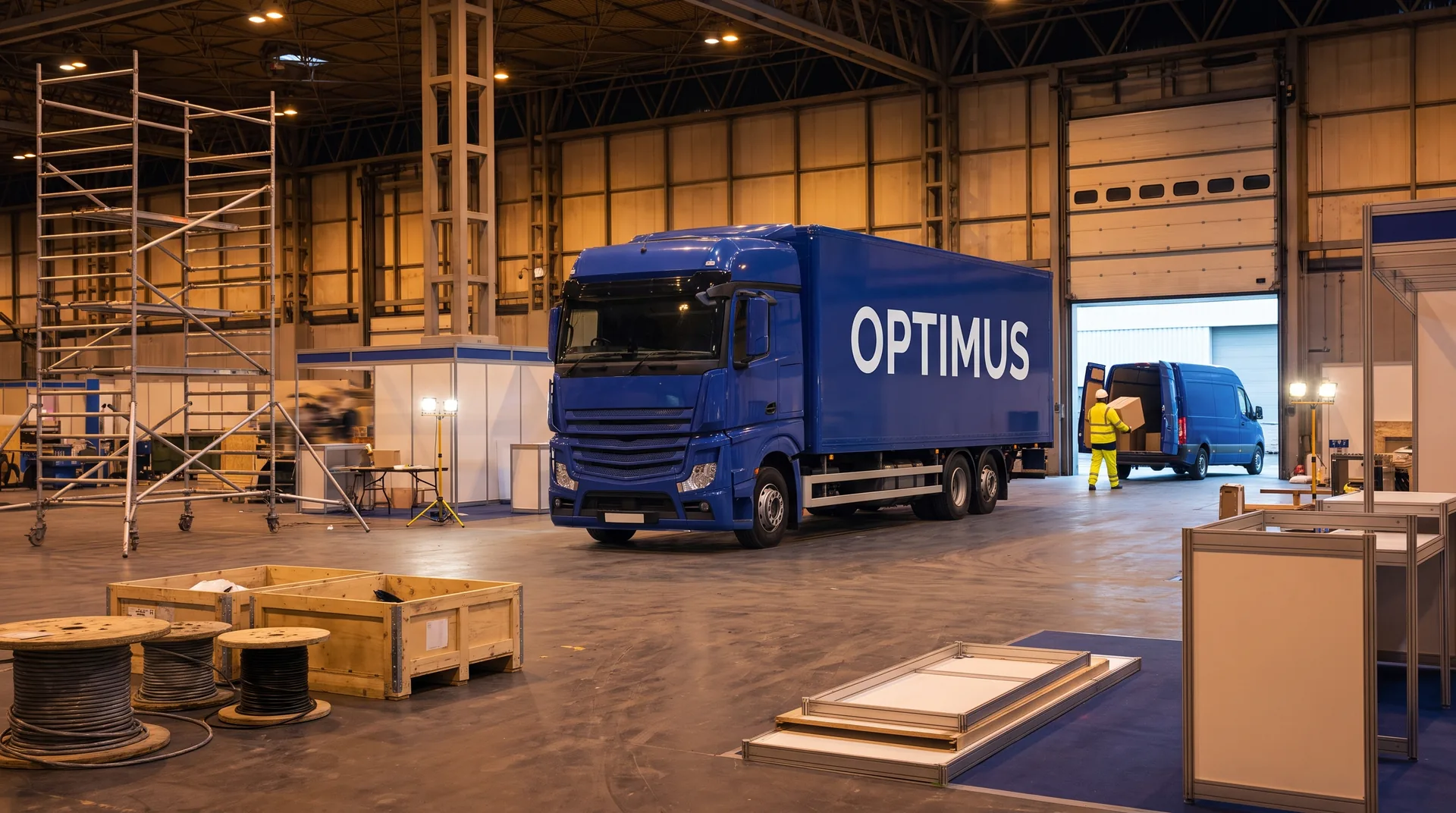
Energy equipment for ENEX travels upright, on a pallet matched to the footprint of the unit and lashed through the frame rather than the casing. The plan starts with one question: does the unit contain refrigerant or a battery module, because that decides the vehicle, the paperwork and how it comes off at the stand.
Why heat pumps and air conditioners must not be laid down
A unit with a refrigeration circuit has a compressor on anti-vibration mounts and oil that should stay in the compressor sump. Laying the unit on its side or tilting it beyond the angle the maker allows can drive oil into the circuit and end in a seized compressor at first start-up. Manufacturers state the permitted tilt angle and the settling time required after transport before the unit is switched on. Those figures come from the manual for the specific model and only they decide; we ask for them at order stage and write them into the transport document as a condition of carriage.
The practical consequence is simple: this cargo travels upright, strapped to the side wall through the load-bearing frame rather than the casing panels, and must not be stacked unless the maker explicitly permits it. The up arrow label is not decoration but an instruction for everyone who touches the pallet along the way. General securing rules are in the article on cargo securing under EN 12195.
Boilers, cylinders and buffer tanks: mass on a small footprint
A floor-standing boiler or a hot water cylinder is a cylinder with a small base and a high mass. On a pallet it behaves differently from a crate: the centre of gravity sits high, so under braking the unit wants to tip rather than slide. That calls for a collared pallet or a steel frame and cross lashing, not a single strap over the top. At unloading the same concentrated mass turns into a point load on the hall floor, which we cover in the article on floor loading and door clearance.
On a fairground there is rarely a dock exactly where the stand is. Unloading therefore happens with a tail lift or with a forklift operated by the hall handling crew. We settle that at enquiry stage, because a tail lift has its own capacity and its own requirements for the ground under the rear axle.
Photovoltaic modules: micro-cracks you cannot see
A PV module looks the same after transport whether it is sound or carries a web of micro-cracks in the silicon. Damage of that kind comes from vibration and point pressure, and shows up only in electroluminescence testing or as a drop in yield. So modules travel in factory packaging, stood on edge as the maker instructs, never flat in a stack without dividers, and never as a base for other cargo. Pallets of modules are strapped with edge protectors so that strap tension does not transfer to the module frames.
Battery storage: when the full ADR regime applies
Domestic and industrial battery storage contains lithium-ion cells, classified in class 9 for road carriage. The detail sits in special provision 188 of the ADR agreement and related provisions: a new, functional battery, properly packed, protected against short circuit and within the energy limits of that provision may travel outside the full ADR regime. A storage unit rated in kilowatt hours does not meet those limits, so the full regime applies: packaging to the relevant packing instruction, marking of packages and vehicle, a transport document and a suitably equipped vehicle.
What surprises exhibitors most is that energy decides, not the size of the enclosure. So at enquiry stage we ask for the capacity in kilowatt hours and the UN number from the product sheet rather than estimating by eye. Classification basics are in the article on ADR classes 1 to 9, and carrying such items in consolidated freight in the piece on ADR in groupage LTL. Delivery is described on the ADR transport page.
Refrigerant in the unit and the carriage rules
A heat pump charged at the factory is equipment containing gas under pressure. Whether the movement falls under ADR depends on the type and quantity of refrigerant and on whether the unit travels as equipment or as a pressure receptacle. The safety data sheet and the maker marking decide, not intuition. Separately there are rules on fluorinated gases, but those mostly concern placing on the market and servicing rather than carriage itself. At order stage we ask for the refrigerant designation and quantity, so the movement is planned once instead of corrected at loading.
Live displays: equipment that has to run on the stand
Increasingly the exhibit does not stand, it works: a heat pump connected to a heat exchanger, an inverter with a module, a boiler on a demonstration rig. That changes two things. First, installation hardware travels with the unit, meaning pipework, circulation pumps, vessels and valves, and it is that hardware which creates the volume. Second, the unit has to arrive in a condition that allows start-up, not just placement, so the settling time question stops being theoretical. We build the schedule so there is slack between unloading and commissioning, as described in the article on the build-up and breakdown calendar.
After the show closes
Demonstration equipment rarely returns to the factory warehouse in the same state: some is sold off the stand, some goes to an installer, some comes back as used kit. Decide that before breakdown, because different options mean different paperwork and different dates. The buffer facility minutes from the fairground is described in the article on the buffer warehouse next to Targi Kielce, and the return options in the piece on what to do with a stand after breakdown.
Sources
Exhibiting energy equipment in Kielce or shipping it to a UK customer? Send the item list with masses, dimensions and refrigerant or battery details through the quotation form. See also exhibition logistics and the United Kingdom direction page.