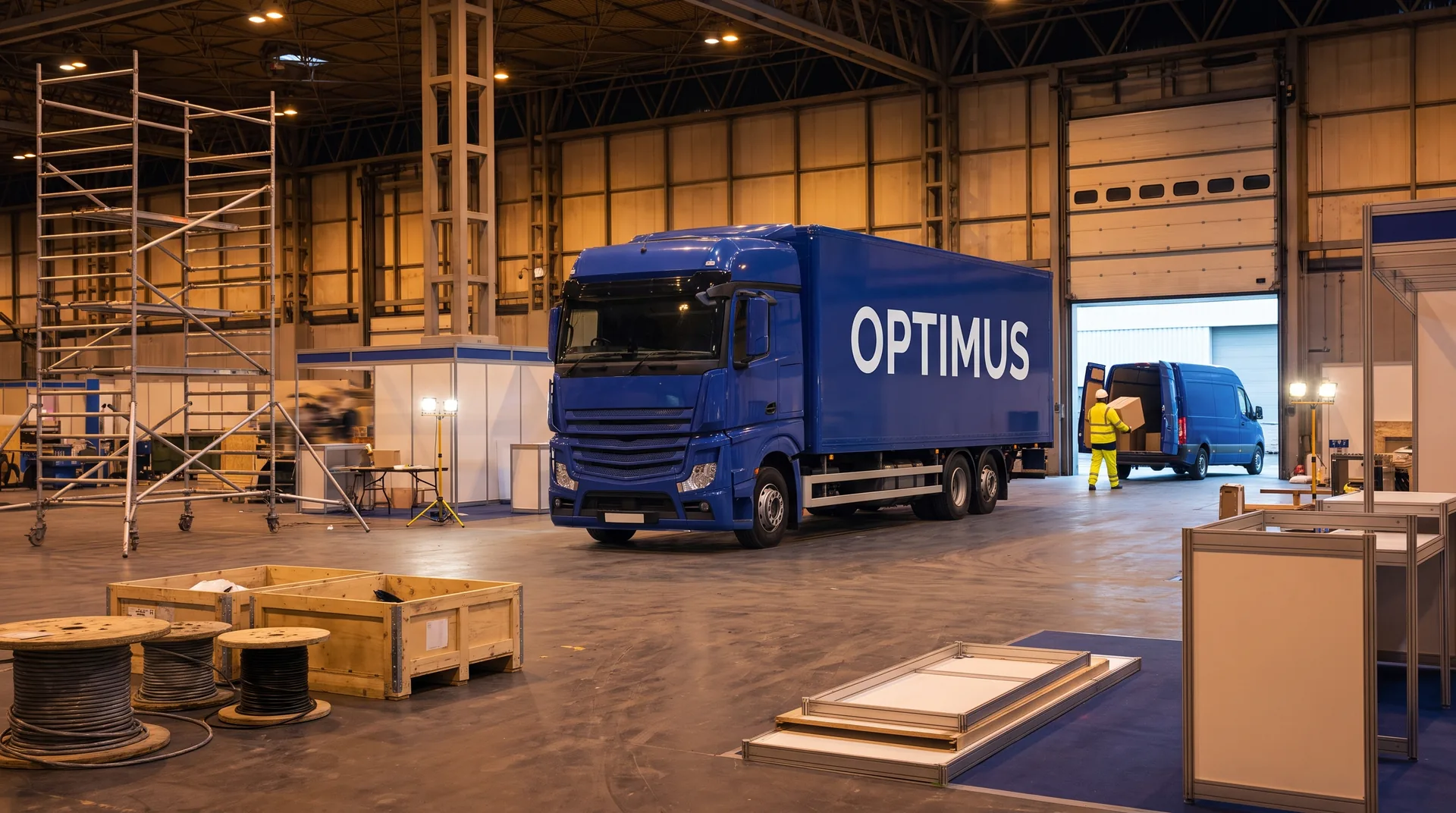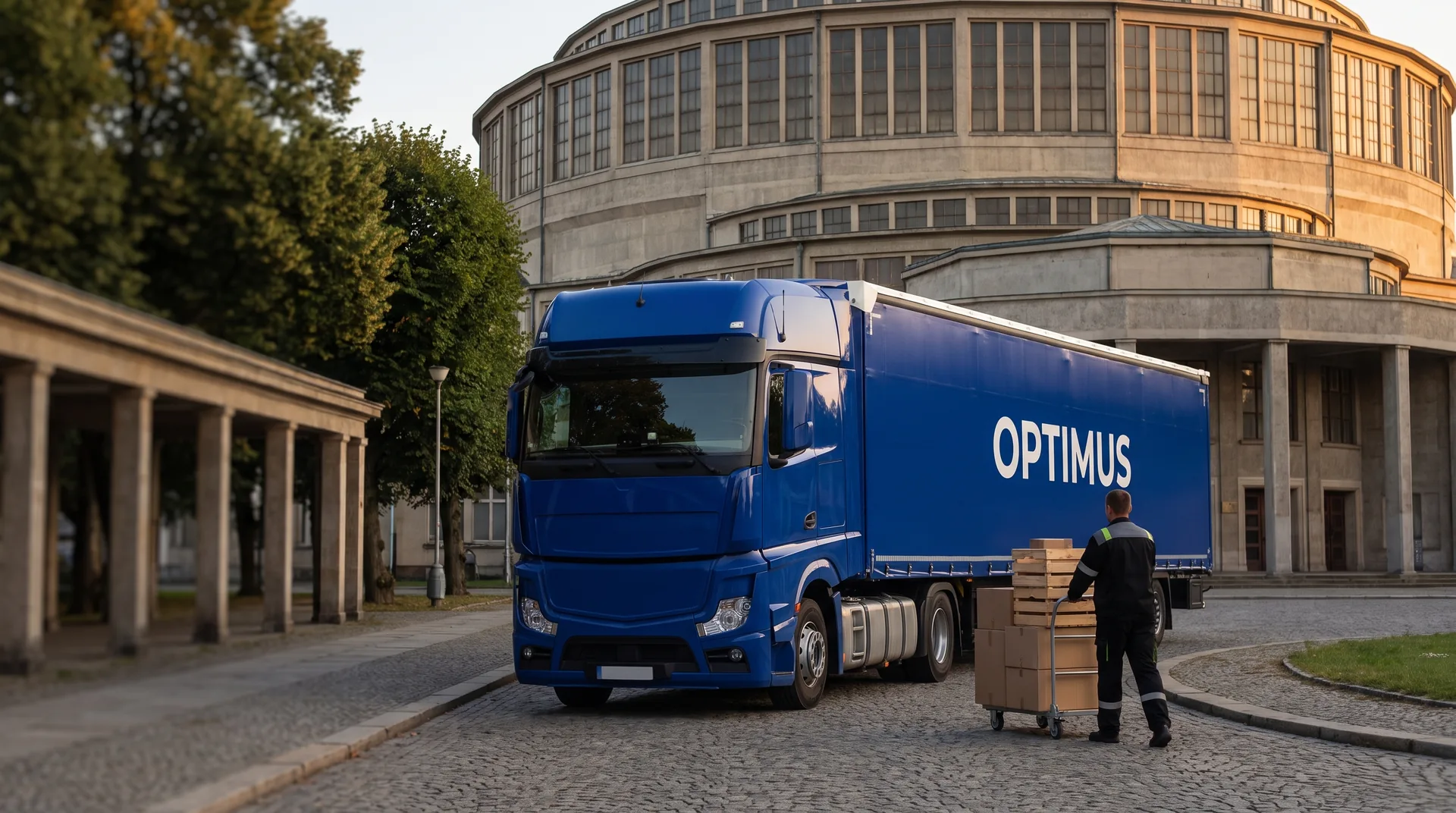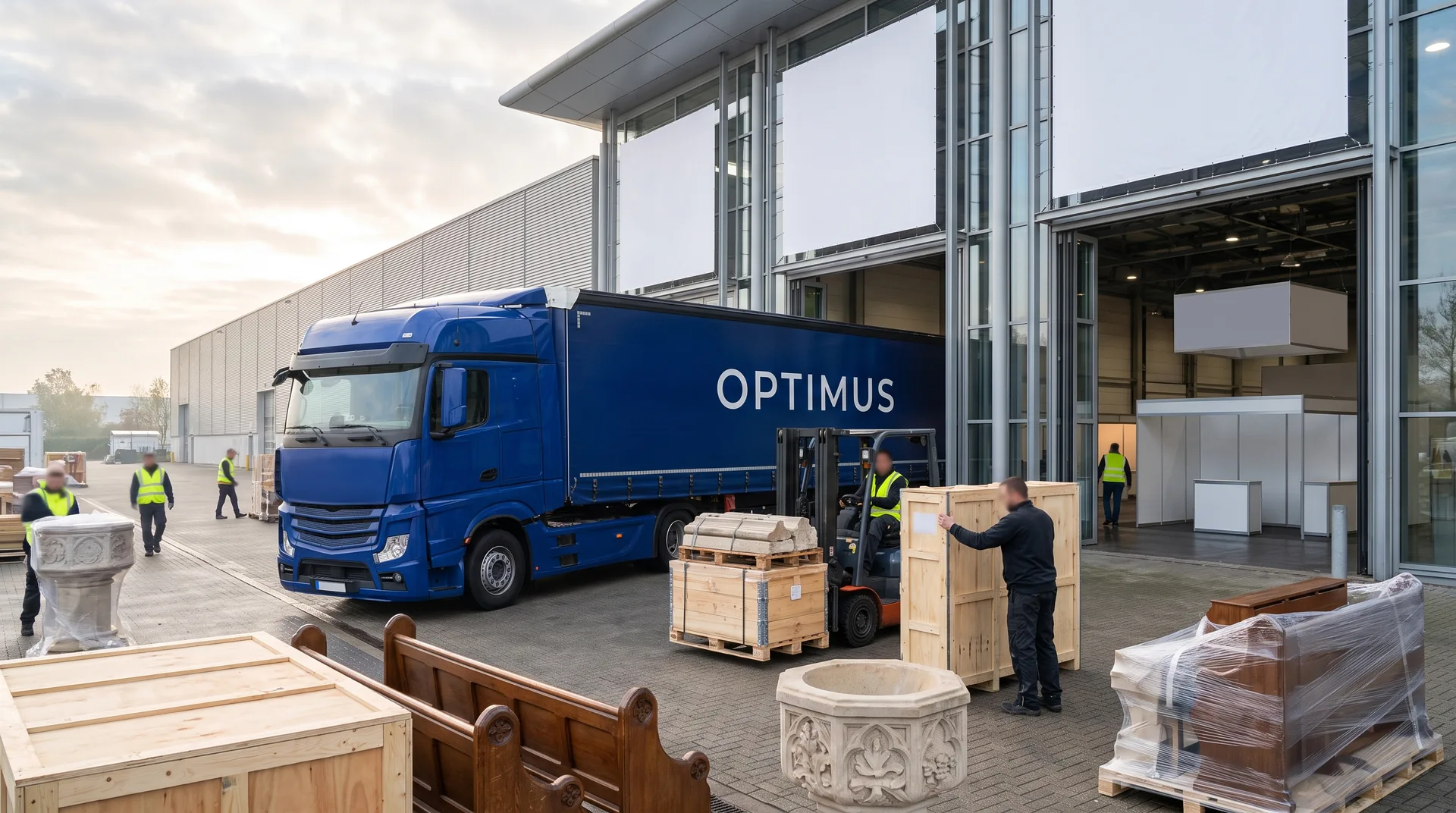
We handle church furnishings for SACROEXPO as one-off cargo: every item gets its own packing, cradle or crate, and the unloading method is agreed before loading, not on the ramp. Our Kielce base sits minutes from the fairground, so an exhibit can wait in buffer storage and enter exactly within its build-up slot.
How does a sacred exhibit differ from a machine on a pallet?
An industrial machine comes with a datasheet: the manufacturer states mass, lifting points, permitted tilt and how to secure it in transit. An altar from a joinery workshop, an organ case or a two-metre limewood figure has none of that. The mass has to be weighed or estimated, the centre of gravity located, and the safe handling points identified together with the maker. That reverses the usual order of work: survey and measurement first, then packing, and only then vehicle selection.
The second difference is that damage is irreversible. A damaged injection moulding machine goes back to the service centre. A cracked nineteenth-century window goes nowhere. With cargo like this we prefer too much protection over too little, and settle every doubt on the cautious side, even when that means a larger vehicle and a longer loading. General rules for exhibition freight are in our piece on exhibit transport to trade fairs; here we focus on what makes church furnishings different.
How do you pack stained glass, statues and liturgical furniture?
Stained glass travels upright, in an A-frame or in a crate with felt-lined slots, separated from neighbouring panels by dividers. Laying a window flat is the classic mistake: the glass itself will take the load, but the lead cames flex with every jolt and can lose their seal after a few hundred kilometres. The crate always carries orientation marks and a no-stacking label.
A figure, especially a polychromed one, needs two layers: the inner layer must not stick to the painted surface, so acid-free tissue or soft fleece goes first and foam plus a rigid shell over it. Protruding parts, meaning hands, attributes and rays of a gloriole, are protected separately, because those break first. Liturgical furniture, an altar, pulpit or confessional, usually travels in modules, each wrapped in a removal blanket and strapped to the side wall with edge protectors spreading the load. The securing rules are the same as in any road transport and we cover them in the article on cargo securing under EN 12195.
When do a bell or an organ become oversized cargo?
A bell alone rarely breaks dimensional limits: even a heavy one is compact and fits in a trailer. The problem is mass concentrated on a small footprint, which transfers to the trailer floor and then to the hall floor. An organ case is often the opposite: light for its volume, but tall, so it is the height that decides whether the run is within legal limits. Measurement decides, never impressions.
If measurement shows the dimensions, masses or axle loads are exceeded, the run needs a permit. Permit categories, issuing authorities and processing times are published by the Polish national roads authority; for higher categories the office may take a couple of weeks, so the application is not something you file in build-up week. We describe such work in our page on oversized loads, and the final metres, meaning the way into the hall, in the article on floor loading and door clearance.
Collection from a parish, a studio or a conservation workshop
Sacred exhibits rarely wait on a loading dock. We collect them from a courtyard workshop, a sacristy, a first-floor studio or straight from a church, where there is neither dock nor forklift. So at enquiry stage we ask about things that never matter with an ordinary pallet: door and gate width, threshold height, the surface in front of the building, whether a trailer can approach or a smaller vehicle is needed, and whether anyone on site will help carry. The answers decide the vehicle and the crew size.
We also settle who dismantles the exhibit at origin. Taking a figure off its plinth or breaking down an altar is work for a joiner or a conservator, not for a driver. Agreeing that before departure saves an hour of argument in the doorway.
Unloading at the stand: who places the exhibit
The carrier delivers to the agreed point on site and takes part in unloading. Positioning the exhibit in its final place on the stand, levelling it, assembling parts and connecting power is the exhibitor or contractor side of the job. The line blurs when the fitting crew runs hours late, which is why we write the scope into the order. Who answers for what in that arrangement is covered in the article on responsibilities at a trade fair. Separately, check whether handling equipment inside the hall is reserved for the operator appointed by the organiser, a topic we take up in the piece on the official fair forwarder versus your own carrier.
Insurance: why the CMR limit is not enough here
Carrier liability in international carriage is capped by weight of the missing goods, not by their value. With light and valuable cargo, and church furnishings almost always are, the cap covers a fraction of the real loss. We explain the mechanism in the article on carrier liability and the 8.33 SDR per kilogram limit. The practical conclusion is simple: with a one-off exhibit we ask for the value and propose cargo cover matched to it, rather than relying on the carrier policy. A separate question is the period when the exhibit stands on the stand and is no longer in carriage, covered in the piece on insuring an exhibit at a trade fair.
The return after the show closes
Once SACROEXPO closes, some exhibits go back to the workshop, some travel straight to a buyer and some stay in Kielce until a return load is complete. Keep the packing materials: a crate built for one specific figure is still the best packing for that figure, and throwing it out on Friday evening means building a new one before the return. At our Kielce base the stand and the crates can wait between build-up and breakdown, as described in the article on the buffer warehouse next to Targi Kielce.
Sources
- Targi Kielce: SACROEXPO exhibition page
- GDDKiA: abnormal load permits, categories and processing times
Do you have a sacred exhibit to move to a fair or to a buyer in Poland or the UK? Write through the quotation form with dimensions, approximate mass and collection conditions. Our fair logistics is summarised on the exhibition logistics page, and the British market on the transport to the United Kingdom page.