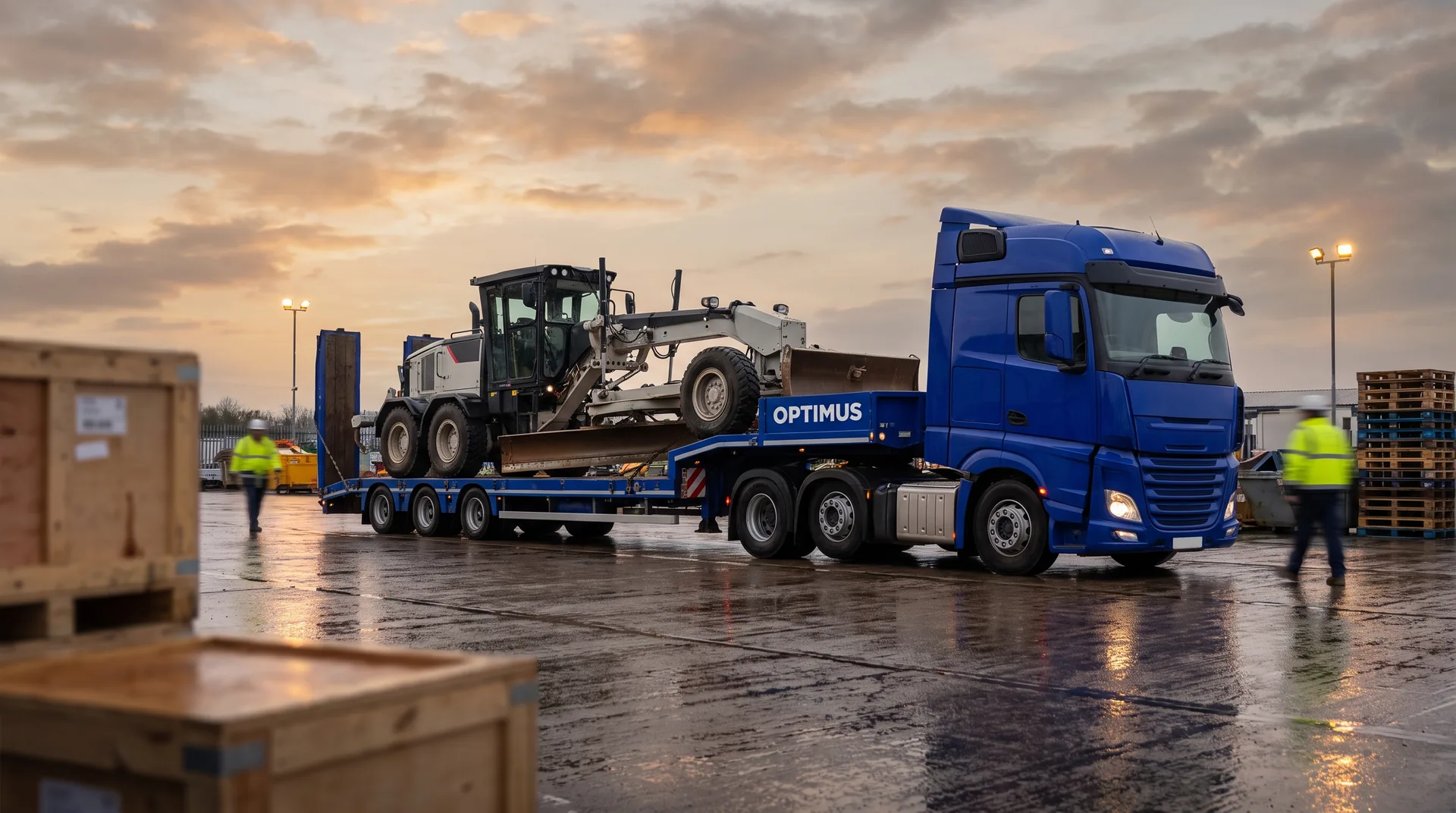
A motor grader is a long machine of moderate weight, so the trailer type and the permits follow its longitudinal dimension rather than its tonnage. A three section frame with the mouldboard slung in the middle does not fold into anything shorter: the blade can be turned along the axis of the machine, but the frame itself cannot be shortened. That decides the choice of vehicle.
A length that cannot be folded away
An excavator folds its boom, a loader takes off its bucket, a telehandler retracts its boom. A grader has nothing to fold: its length comes from a frame that has to be long so the blade between the axles works steadily. Turning the mouldboard along the axis of the machine reduces width but not length. Removing the rear ripper or the front dozer blade, where fitted, shortens the load by however far those parts project, and that is the entire margin available.
The consequence is simple: with this machine the permit question is asked while bidding, not after. Permit categories and processing times are published by GDDKiA, and the British notification side is described in our piece on oversized transport to the UK. Both processes run independently and both have to be closed before departure.
Mouldboard, circle and ripper
- The blade is turned along the axis of the machine and locked in the circle. Set at an angle it projects on both sides at once.
- The circle and the side shift mechanism have a transport position described in the manual. Without the lock the blade travels sideways en route and changes the outline of the load without the driver knowing.
- The ripper and the front blade are raised and locked mechanically or removed; rams are capped after removal and rods are covered.
- The frame articulation is locked where a transport lock exists; an articulated grader without it jack-knifes under braking.
- Leaning front wheels are set upright, because when leaned they change the track width and the width of the machine.
Weight distribution on a long load
On a long, relatively light machine the problem is not overload but distribution. The weight concentrated over the middle of the frame lands on one stretch of the trailer while the ends of the machine reach beyond the supported area. The position on the deck is settled before the machine comes down onto the timbers, because repositioning a long load afterwards means driving it up again. Chocks go under every axle, lashings into the points the maker specifies, and tension is checked after the first leg. The rules for calculating forces are collected in the article on cargo securing under EN 12195.
Loading: under its own power or on the winch
A working grader climbs the ramps on its own wheels, but it needs a long, straight approach, because a machine with that wheelbase does not manoeuvre in front of a trailer the way an excavator does. The auction yard has to have the space and a firm surface, and that is the question we ask before despatching the vehicle. A dead machine goes on the winch, which at this length means still more room behind the trailer. The options are described in the piece on loading a machine at the auction yard, and the checklist for an auction machine in the article on inspection before collection.
Fluids, fuel and battery
Graders from highway fleets and hire companies are often well worked, and leaks on the blade rams and in the steering circuit are typical here. We check them before loading, because oil dripping from the middle of the deck spreads along its whole length. The fuel level is agreed with the yard before collection, because fuel type and tank construction decide whether the movement falls under dangerous goods rules. The battery is disconnected, the terminals protected, the keys travel with the paperwork.
Cleaning and border formalities
A grader works in soil and aggregate, so it brings soil in the blade, in the tread and on the frame. If the machine has been used for agricultural or forestry purposes, bringing it into the Union requires the phytosanitary conditions to be met: a notification in TRACES NT, a CHED-PP certificate and the importer entered in the register kept by the Polish plant health service. We set out the procedure under farm machinery auctions in the UK. On a machine travelling under permit there is a further reason to wash it: a muddy load drops clods along the route, and an abnormal movement is watched more closely than an ordinary one.
Sources
- GDDKiA: permits for abnormal vehicle movements
- GOV.UK: ESDAL and notifying abnormal loads
- DVSA: load securing guidance for vehicle operators
Found a machine and want to know whether it clears without a permit? Send the transport length and the yard address through the quote form. See also oversized loads and our guide to UK machinery auctions. From the same category: a site dumper from the UK.