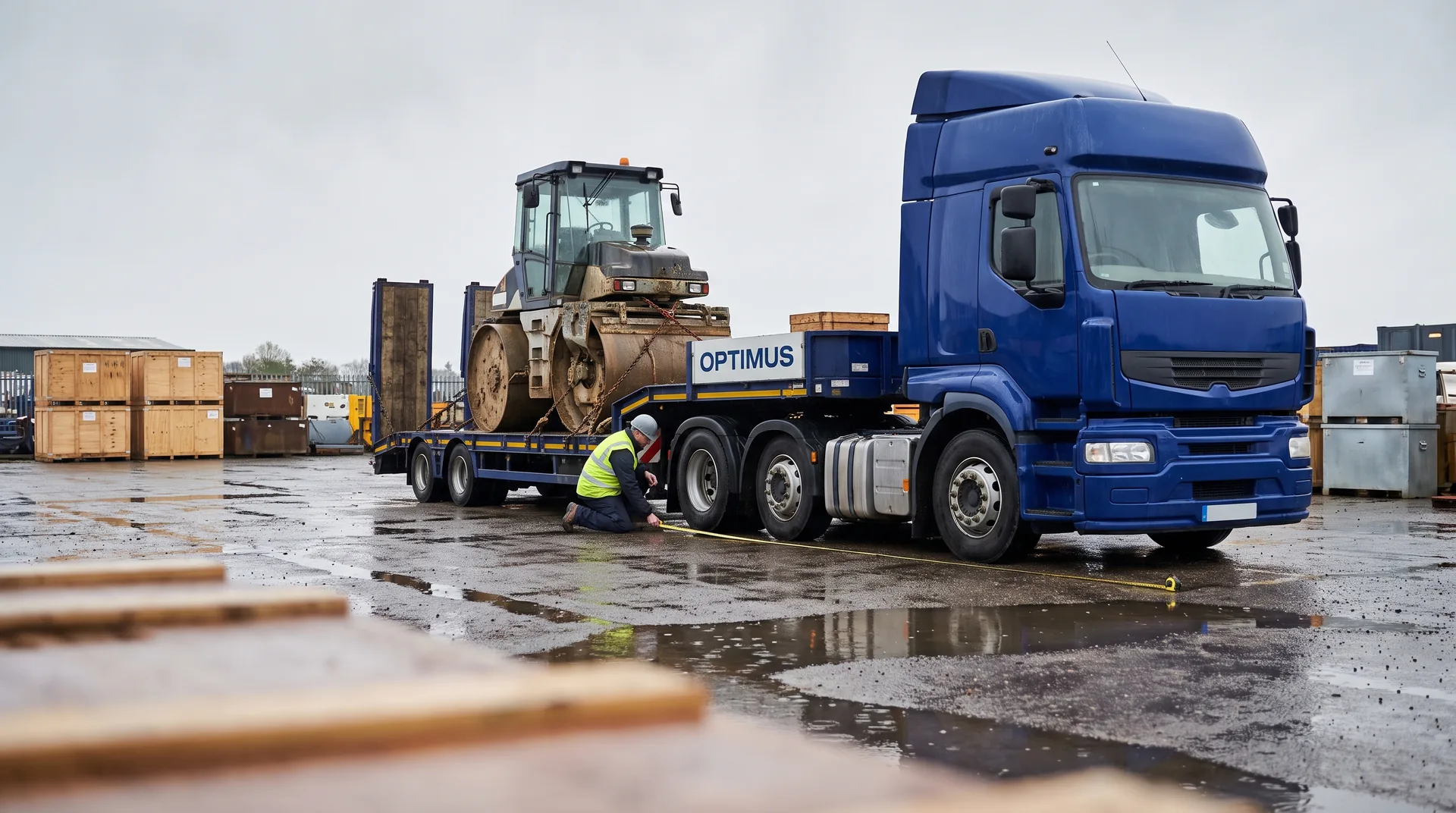
A road roller is a short load and a very heavy one for its length, so the problem in carrying it is not dimensions but how its weight distributes across the vehicle axles. A machine placed too far forward or too far back overloads one axle even though the gross weight is within limits. Its position on the deck is therefore settled before it drives up, not after.
Short, heavy, concentrated
A roller concentrates its weight on two drums, or on a drum and a wheel axle, over a stretch much shorter than the trailer deck. How that weight lands on the vehicle axles depends on where the machine stands, and differences of a few dozen centimetres are noticeable. So with a roller the driver does not place the machine by eye: the position follows from a calculation for that vehicle, that machine weight and that trailer axle spacing. The weight comes from the plate on the unit, not from the brochure for the range, because rollers of the same class differ in ballast.
The second consequence of concentrated mass is deck pressure. A narrow drum spreads weight over a small area, so bearers go under the machine to distribute it, exactly as with heavy attachments.
Ground clearance and approach angle
A roller has low clearance and a long overhang between the drums, so on a steep approach it grounds on the deck edge before the drums reach the trailer. It is the commonest mishap with this machine and force does not solve it. What helps is longer ramps, plates under their feet, using a natural slope on the yard or an existing dock. The loading options are set out in the piece on loading a machine at the auction yard. Grip is checked separately: a smooth steel drum on a wet deck slips at any gradient.
Locks and lashing points
- The frame articulation is locked with the rigid bar the maker provides. An articulated roller without it jack-knifes under braking and throws the weight to one side of the trailer.
- Lashing points differ between designs. Tandem and vibratory rollers have them in different places and the maker gives them in the manual; there is no common pattern to carry over from another machine.
- Straps never go around a drum. The drum is a rotating part on its own bearings, and a strap passed over it does not restrain the machine, it scuffs the shell.
- Chocks go fore and aft of each drum, shaped to the roller, because a straight chock under a round drum does not bear.
- The vibration system is switched off and secured against accidental starting, and versions with rubber tyres stand on bearers.
The rules for calculating forces and choosing lashings are collected in the article on cargo securing under EN 12195.
Fluids, fuel and water in the tank
A roller has a water tank for wetting the drums, and that is its particularity in transport. The water is drained before the road for two reasons: it is weight nobody counted in the axle calculation, and in sub-zero temperatures it splits the spray system. The fuel level is agreed with the yard before collection, because fuel type and tank construction decide whether the movement falls under dangerous goods rules. The battery is disconnected, the terminals protected, the keys travel with the paperwork.
Cleaning and formalities
Roller drums after work on soil are caked with earth and emulsion, and a machine off a road job carries bitumen as well. Before loading we clean the drums and scrapers, because material shedding off them dirties the deck and the neighbouring load. For equipment used for agricultural or forestry purposes, entry into the Union requires the phytosanitary conditions to be met: a notification in TRACES NT, a CHED-PP certificate and the importer entered in the register kept by the Polish plant health service. We set the whole thing out under farm machinery auctions in the UK, and the yard checklist in the piece on inspection before collection.
Sources
- GDDKiA: abnormal movements, permit categories and lead times
- DVSA: load securing guidance for vehicle operators
- GOV.UK: securing loads on HGVs and goods vehicles
Buying a roller and want certainty that the vehicle carries it within axle limits? Send the plate weight and the yard address through the quote form. See also excavators and loaders from UK auctions and customs clearance. Related topic: a plate compactor and rammer from the UK.