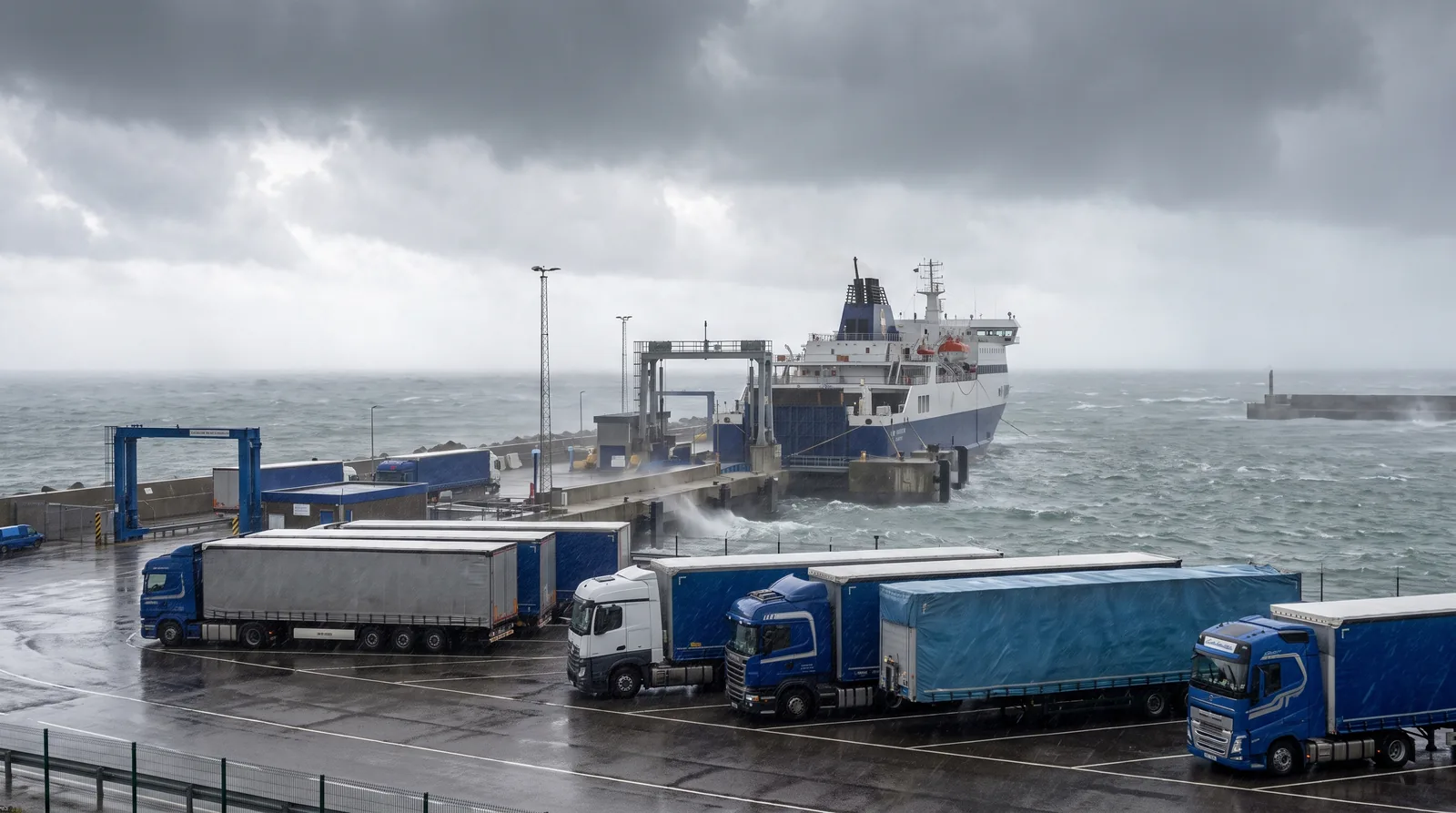
When a storm suspends sailings the cargo is not lost, it waits: operators move vehicles onto the next available departures and the queue clears over hours. The forwarder's job at that moment is rebooking onto the first realistic sailing or switching corridor, informing the consignee immediately and moving the unloading window before anyone starts counting losses.
What happens at the port
Suspended traffic does not mean lost sailings: it means they all pile up. A driver sitting in the queue cannot speed anything up, because he has access neither to the booking nor to the operator's system. Decisions are taken on the forwarder's side: hold the booking and wait, or move the vehicle to where traffic is already flowing. The answer depends on how long the suspension is expected to last, how many vehicles are ahead of us and whether the cargo has a hard deadline on the far side.
Plan B: the other crossing or another port
On a short corridor plan B often sits across the same motorway. The tunnel shuttle does not depend on the state of the sea, so with ferries cancelled it is the natural first choice, provided the cargo is not excluded from the tunnel. Restrictions apply above all to dangerous goods, covered in ADR by ferry and Eurotunnel. Next in order come sailings from other ports, described in east coast ports, and simply moving to the next free departure. The mechanism for choosing a crossing is taken apart in how we choose the crossing.
Why a freight account matters
When hundreds of vehicles are chasing space at once, who gets it is decided not by politeness but by the booking and the relationship with the operator. A carrier with its own freight account and a history of movements rebooks in the system rather than asking for space by phone. That is the difference between an hour and a day of delay. What such a booking contains and why its content matters when things change is described in what a freight ferry booking includes.
The consignee must know before their ramp does
The most expensive consequence of a storm is usually not the crossing itself but the lost unloading window. British warehouses run on booked slots: a vehicle half a day late without warning can go to the back of the queue and lose a day, even if it is physically standing at the gate. So the consignee hears from us as soon as a sailing is cancelled, with a new estimated hour and a request to move the slot. A call from the driver at the gate is the worst form of communication, because it arrives when nothing can be changed. How booking-in works is described in booking-in at UK warehouses.
Who carries the weather risk
A storm is a circumstance the carrier cannot remove, but that does not release it from the duty to act. What counts is a documented cancellation, prompt notice to the customer and the choice of a reasonable alternative. Settlement of any delay depends on the contract and on carriage law, so instead of promising that weather does not affect us, we show how we limit its cost. The scope and limits of force majeure are taken apart in force majeure under CMR, and waiting costs in waiting time charges on UK transport.
What we do to make a storm cost less
- On critical deadlines we book the crossing with margin rather than to the minute.
- We check in advance whether the cargo can use an alternative corridor, before it becomes necessary.
- In winter we plan Channel routes with an extra buffer, especially for slot deliveries.
- We tell the consignee about a disruption as it happens, not afterwards.
- For sensitive cargo we keep a place to drop the load on the British side, so goods do not sit in a trailer for no reason.
Sources
- DFDS: sailing and disruption information for the Channel
- GOV.UK: import goods into the UK step by step
Have a delivery with a date that cannot move? Describe the cargo and the required date through the quote form and we will plan the route together with a fallback. The whole lane is described on the transport to the United Kingdom page.